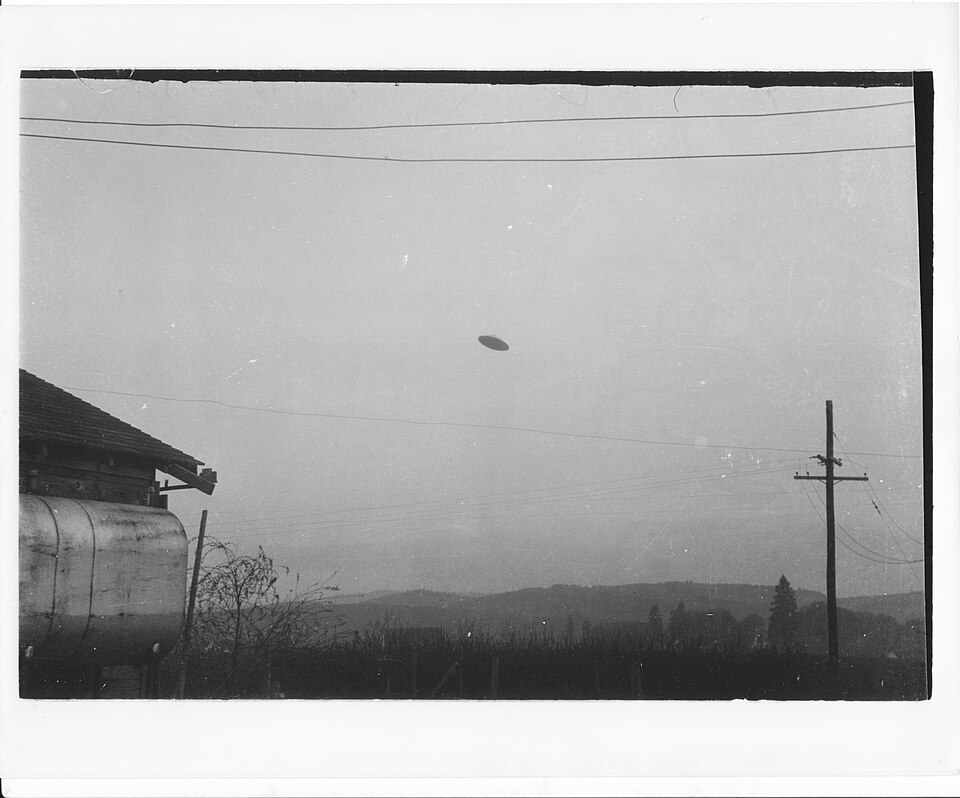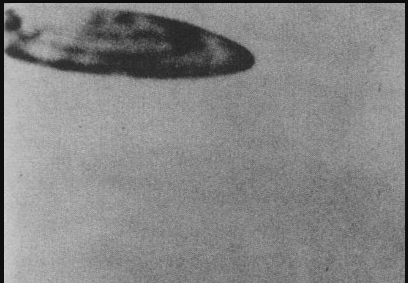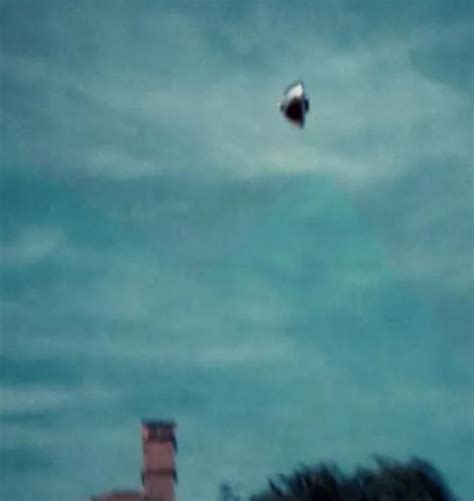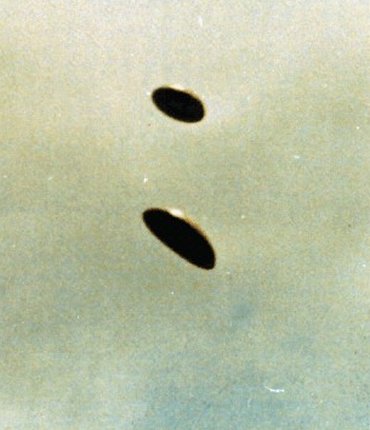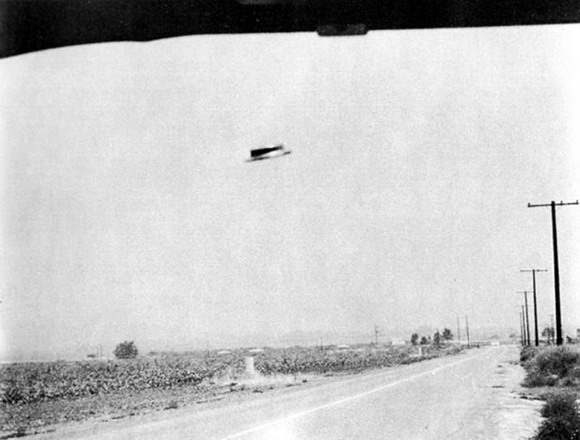
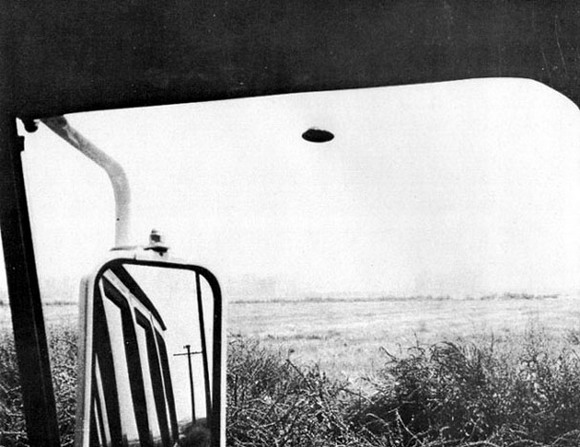
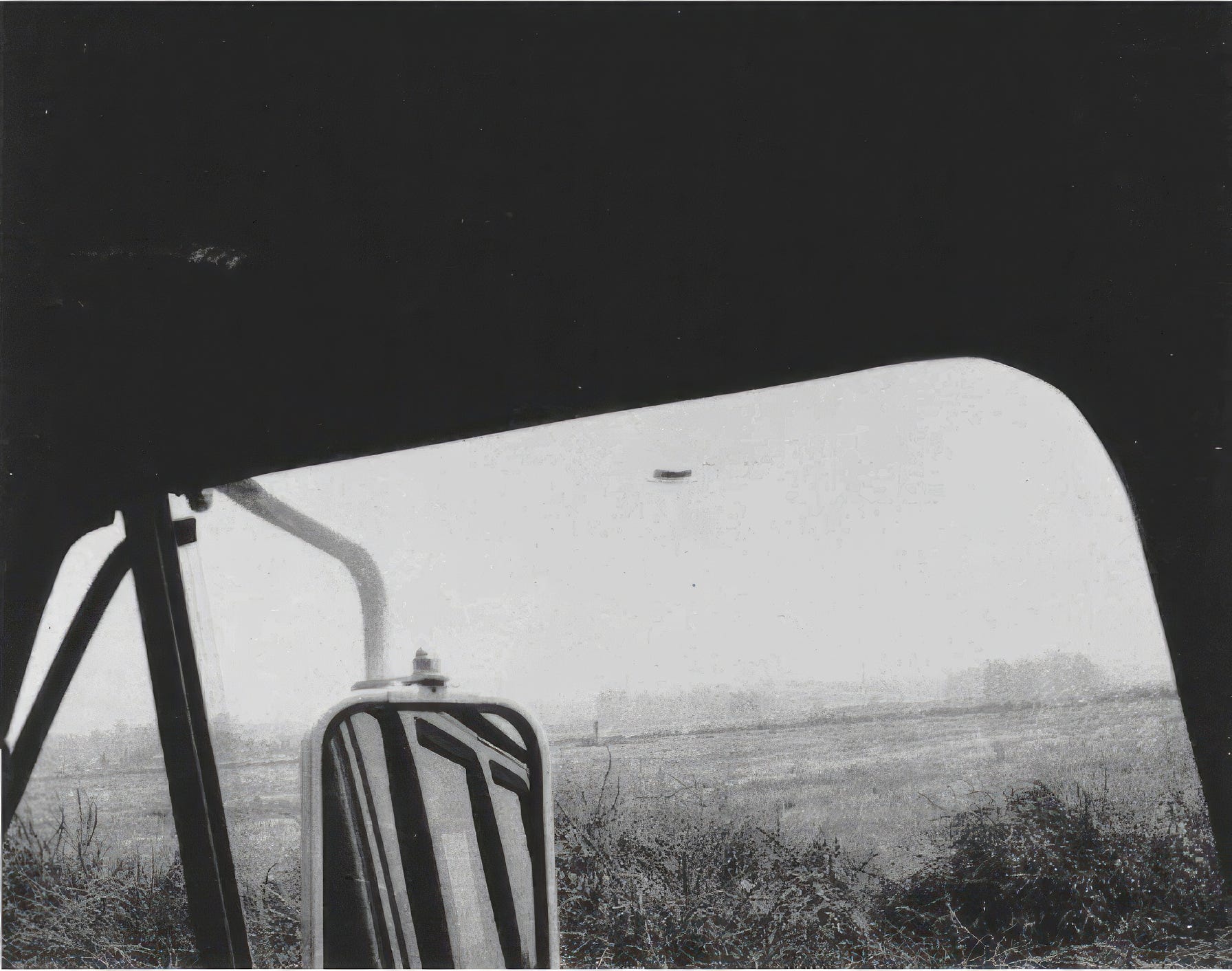
On the afternoon of August 3, 1965, Rex Heflin, a highway traffic inspector for the Orange County Road Department, was parked in his work truck on Myford Road near Santa Ana, California when he observed an unusual disc shaped object hovering above the road ahead of him. Heflin had a Polaroid camera in the cab of the truck for his official work documentation duties. He retrieved it and took three photographs of the object while it hovered at low altitude, and a fourth photograph showing a black smoke ring that remained in the air at the spot where the object had been after it departed sharply to the upper right. The four photographs together represent one of the most discussed and most technically analyzed sequences in the American UFO photograph archive.
The object in the photographs has a distinctive hat brim or saucer shape, with a domed upper surface and a flat or slightly concave lower surface. The underside has what appears to be a circular band or rim detail visible in the images. In the first three photographs the object is seen at progressively different angles as Heflin repositioned his camera through the cab window, and the object appears at a low altitude above the road surface with telephone poles and road infrastructure visible for scale reference. The fourth photograph, showing the circular smoke ring hanging in the air at the point of the object's last position, is without parallel in the contemporaneous UAP photograph record.
Heflin reported that his two-way radio malfunctioned during the encounter, producing only static while the object was present. Radio interference associated with UAP encounters was a commonly reported phenomenon in the 1960s and would become one of the most discussed secondary effects in UAP witness accounts of the era. Whether this detail is verifiable or represents a post hoc addition to the account has been a point of debate among researchers, though Heflin included it consistently in his earliest accounts given before any significant public attention had shaped his narrative.
The photographs were initially given to a reporter from the Santa Ana Register, who published them in September 1965. The images attracted immediate national attention and were reproduced widely in newspapers and magazines. Shortly after their publication, individuals identifying themselves as representatives of the North American Air Defense Command called on Heflin and took his original Polaroid prints, providing him with copies. The originals were never officially returned and NORAD later denied having sent anyone to collect them. This episode, in which military affiliated individuals apparently confiscated original UAP photograph evidence, became one of the most discussed instances of alleged evidence retrieval in the history of American UAP documentation.
The original prints resurfaced decades later in 1993 when an anonymous package containing the three object photographs arrived at a UAP research group in California. Examination confirmed they were the original Polaroids rather than the copies Heflin had retained. Who had held the photographs for the intervening 28 years, how they came to be returned anonymously, and whether any analysis was performed on them during that period has never been established. The return of the originals allowed modern photographic analysis to be applied directly to the source material for the first time since 1965.
Project Blue Book reviewed the Heflin photographs and interviewed Heflin as part of its routine case processing. The program did not assign the case its highest priority designation despite the photographs' unusual quality, partly because the originals had been removed from Heflin's possession before Blue Book investigators could examine them directly. Analysis was therefore conducted on the copies rather than the Polaroid originals, a significant limitation given that Polaroid film carries characteristic marks that help authenticate the generation of any particular print.
The University of Colorado UFO Project, the Condon Committee, also reviewed the Heflin photographs. Analyst Dr. William Hartmann, who had given the McMinnville photographs a generally favorable assessment, analyzed the Heflin images and concluded that they were consistent with a small model photographed at close range rather than a large craft at distance. His primary argument was the apparent sharpness of the object relative to the background and the relationship between the object's apparent size and the road and telephone pole reference features. This conclusion placed the Heflin case on the unfavorable side of the Condon Report's photographic assessments, in contrast to McMinnville.
The return of the original Polaroid prints in 1993 prompted a new round of technical analysis. A team including physicists and photographic experts from the MUFON organization applied modern photographic analysis techniques to the originals. Their analysis examined the Polaroid emulsion characteristics, the object's edge definition relative to focus at different distances, and the smoke ring photograph's consistency with a genuine atmospheric phenomenon. Their conclusion was broadly favorable to authenticity, finding the photometric properties of the images more consistent with a large object at distance than a small model nearby.
The specific evidentiary question raised by Hartmann concerned whether the object's sharpness was consistent with a close foreground model or a distant large craft. This question has a definitive photographic answer in principle: a Polaroid camera's fixed focus characteristics create a specific depth of field relationship that constrains the range at which an object of a given apparent size could be sharply rendered. Whether the Heflin photographs' focus characteristics are fully consistent with either the model hypothesis or the distant craft hypothesis has been argued in both directions by different analysts applying different assumptions about the camera's optical characteristics.
The NORAD originals confiscation episode has been investigated by multiple researchers over the decades and remains unexplained. NORAD's denial of having sent anyone to collect the photographs was never supported by any investigation that actually traced who the individuals who visited Heflin were. The anonymous return of the originals 28 years later adds a further unresolved dimension to the provenance story that bears directly on any analysis of the photographs themselves, since the chain of custody during that 28 year gap is entirely unknown.
Project Blue Book's disposition of the Heflin case was inconclusive, and it was not assigned a definitive conventional explanation. The Condon Report's analysis by Hartmann leaned toward the small model hypothesis but acknowledged the analysis was limited by working from copies rather than originals. No government body has ever issued a definitive official conclusion that either authenticates or debunks the photographs, leaving the case in a state of permanent official ambiguity.
The smoke ring photograph is the most distinctive and least addressed element of the Heflin sequence. Smoke or vapor rings can be produced by various propulsion and exhaust mechanisms, including jet engines and pulse detonation devices, but the perfectly circular symmetry and atmospheric persistence described and photographed by Heflin are unusual. If the ring photograph is genuine, it represents physical evidence of a propulsion exhaust phenomenon at the object's last position that provides independent corroboration of the object's presence and departure direction independent of the three object photographs.
The confiscation of the original Polaroid prints by unidentified individuals claiming military affiliation, combined with NORAD's denial and the unexplained 28 year disappearance and anonymous return, represents the most consequential chain of custody disruption in the entire American UAP photograph archive. Whatever the photographs ultimately show, this episode demonstrates that someone with sufficient access and motivation to present false military credentials was sufficiently interested in these specific photographs to take the risk of removing them from a witness's possession in 1965.
The Heflin photographs occupy an important position in the UAP photograph record as one of the few cases in which a short sequence of images captures an object at multiple stages of an encounter, including the object's presence, apparent movement, and departure evidence in the form of the smoke ring. The sequencing gives this case a narrative coherence that single images lack and makes the fabrication scenario somewhat more complex than for a single posed photograph.
- Q.01What do the original Polaroid prints now show under modern high resolution digital scanning and emulsion analysis? The 1993 returned originals were examined in the 1990s but modern digital densitometry, high resolution scanning, and computational photogrammetry tools available today could extract significantly more information from the Polaroid emulsion than was possible then. Whether the current location of the originals is known and whether they are accessible for contemporary analysis has not been established in recent public accounts of the case.
- Q.02Who took the original Polaroid prints, and who returned them anonymously 28 years later? The individuals who visited Heflin identifying themselves as NORAD representatives were never traced or identified despite NORAD's denial. The anonymous package containing the originals in 1993 was never traced to a sender. Whether any investigative effort was made to determine the sender's identity through postal forensics, paper analysis, or other means, and what that investigation found, has not been established in any public account of the case.
- Q.03Does the radio interference Heflin reported have any corroborating evidence from other radio users in the area at the time? If Heflin's two way radio was genuinely disrupted by electromagnetic interference during the encounter, other radio users in the immediate area might have experienced similar disruption simultaneously. Whether any attempt was made to identify and contact other radio users in that area of Santa Ana on the afternoon of August 3, 1965 to check for corroborating interference reports has not been established in available investigation accounts.
- Q.04What is the photographic physics assessment of the smoke ring image? The fourth photograph showing a circular vapor or smoke ring hanging in the air where the object departed is without clear parallel in the UAP photograph record. Whether the ring's apparent size, shape, atmospheric persistence, and photographic characteristics are consistent with a genuine aerodynamic or propulsion phenomenon, and what type of exhaust mechanism could produce a ring of that geometry at an apparent altitude above a road, has not been addressed in any detailed technical analysis in the public record.
- Q.05Were there other witnesses in the Myford Road area during or near the time of Heflin's encounter? Myford Road was a public road in an industrial and agricultural area of Orange County. Whether any other drivers, workers, or residents in the area observed the object or the smoke ring, and whether they were systematically interviewed by any investigator, has not been established in public accounts of the investigation.
- Q.06What does the Heflin case reveal about the evidentiary consequences of failing to protect original UAP photographic evidence? The removal of the original Polaroid prints by unidentified individuals permanently compromised the evidential foundation of one of the most detailed UAP photograph sequences of the 1960s. In every subsequent era of UAP investigation, the question of evidence custody and protection has remained unresolved: who has authority to secure original UAP sensor data, what chain of custody protocols exist, and what institutional mechanisms prevent the kind of unauthorized evidence removal the Heflin case documents. The absence of clear answers to these questions in AARO's current operational framework suggests that original sensor evidence from a significant new encounter could be equally vulnerable to loss or unauthorized access today.