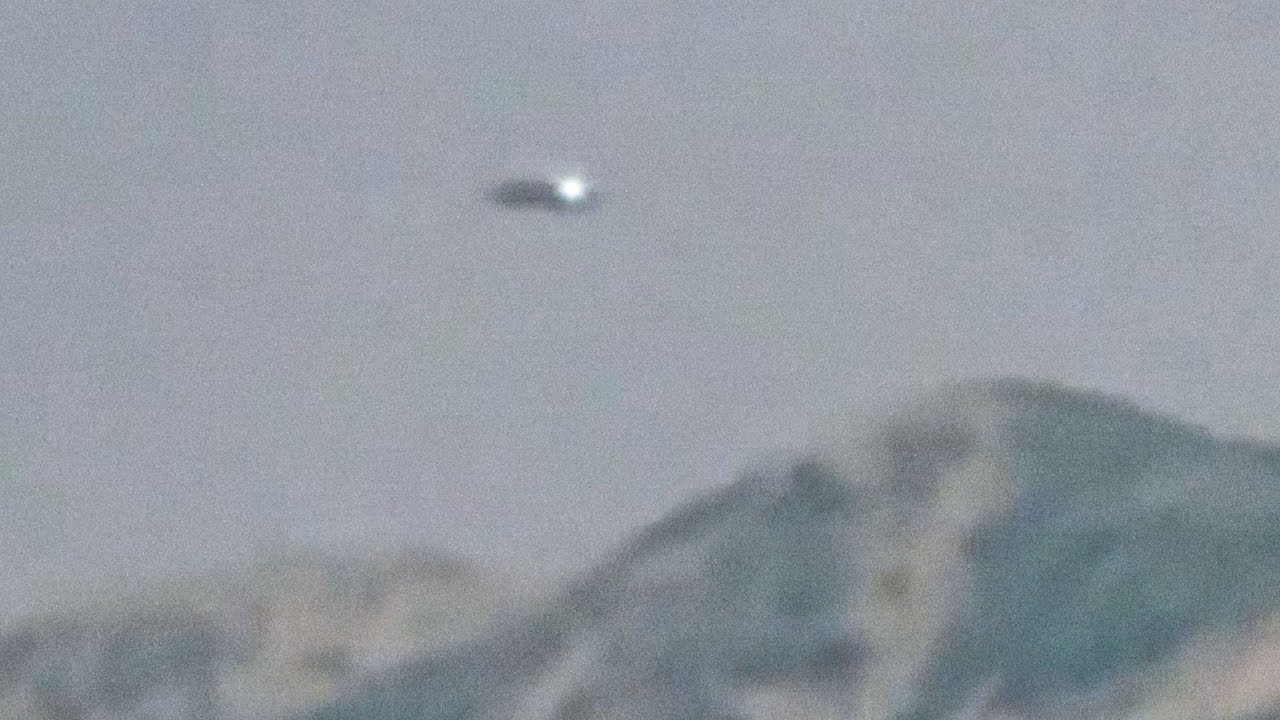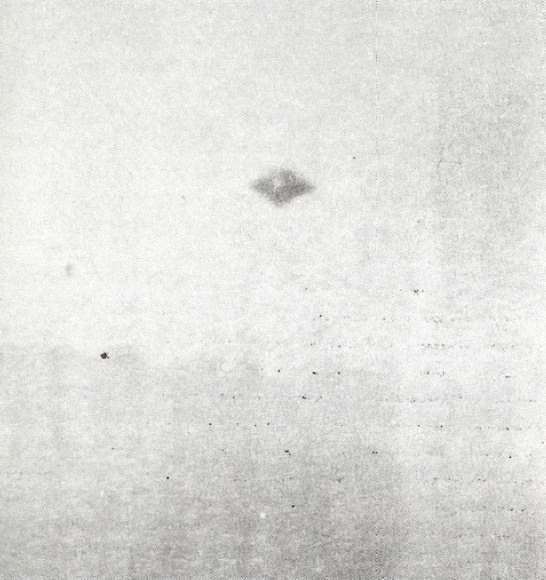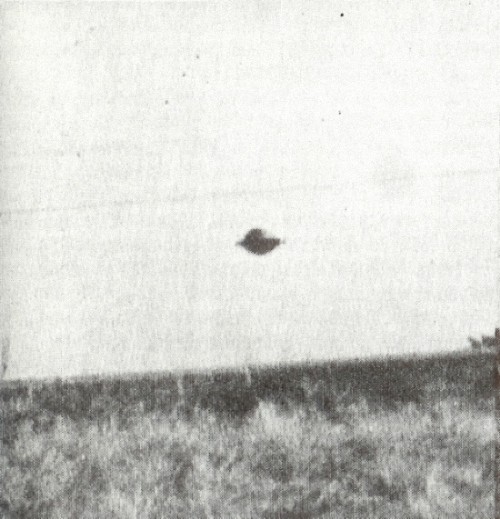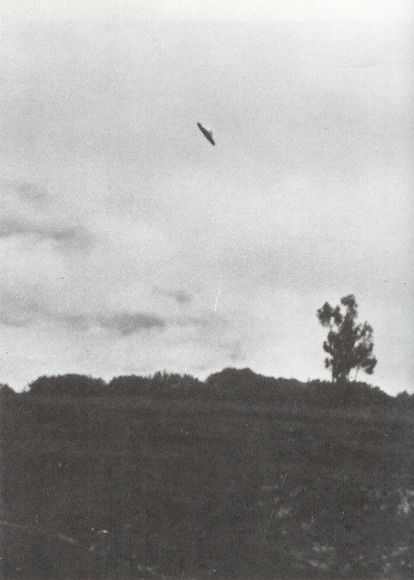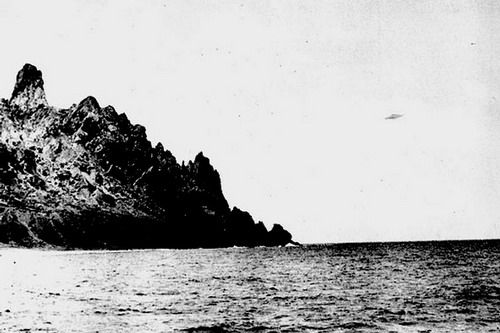
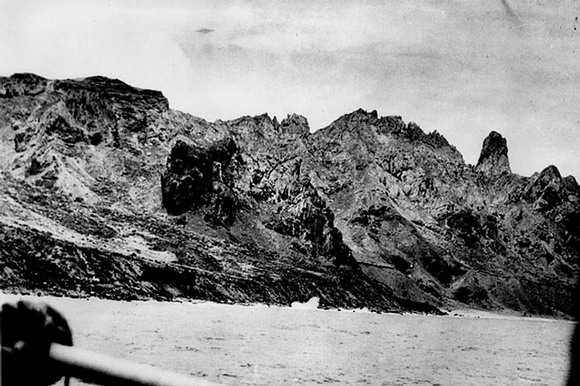
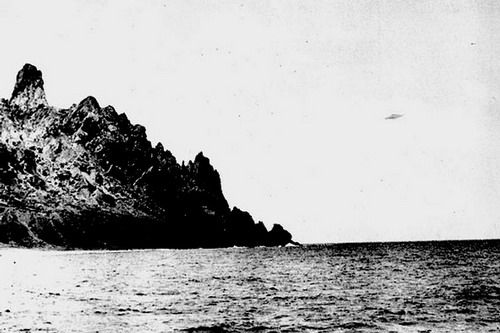
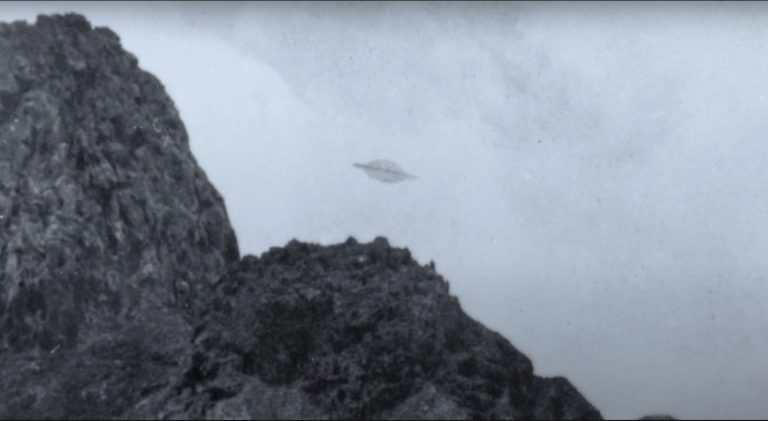
Trindade, a small rocky island in the middle of the South Atlantic Ocean approximately 600 miles off the coast of Bahia, Brazil, was the site of one of the most impressive photographic cases in UFO history. In October 1957, the Brazilian Navy set up a small scientific base on the unoccupied island, where oceanographic and meteorological research would be conducted in connection with the International Geophysical Year. Starting early the next month, instrument-bearing weather balloons were launched daily. They were designed to explode in the upper atmosphere, releasing the instrument packages which would parachute to earth to be retrieved by the researchers. By the end of the month, base personnel were reporting silvery UFOs which seemed to be monitoring the balloons' movements.
On January 1, 1958, at 7:50 a.m., the passage of a bright point of light, like a mirror reflecting sunlight, was observed by the entire garrison. The next evening, a round object with an orange glow circled the Navy tow ship Triunfo traveling off the Bahian coast 400 miles from Trindade. As the crew watched, the UFO executed sudden right-angle turns and at other times hovered near the ship. The sighting lasted for 10 minutes.
The most fantastic event occurred on January 6. The base's chief officer, Cmdr. Carlos A. Bacellar, had just overseen the launching of a weather balloon into a morning sky clear of everything but a single large cumulus cloud at 14,000 feet. Inside the radio cabin, Bacellar listened to the signals the balloon emitted as it ascended. Suddenly those signals inexplicably diminished, then went dead. When Bacellar went outside to investigate, he saw nothing out of the ordinary, at least at first. The balloon was ascending normally — until it came directly below the cloud, at which point it seemed to be sucked abruptly upward. For the next 10 minutes it remained out of sight and inside the cloud. Finally, when it reappeared, it was above the cloud and devoid of the instrument package.
Soon a silvery object emerged from behind the cloud. As it moved slowly from the southwest to the east, a technician gazing through a theodolite spotted it and alerted the commander, who viewed it briefly through binoculars, then through a sextant. Crescent-shaped and bright white in color, the object reversed course at one point and remained in sight for some time before it entered a cloud bank.
Later that day, on January 16, 1958, at 12:15 p.m., as the Almirante Saldanha sat anchored off the south coast of Trindade and prepared for a return trip to Rio de Janeiro, 48 crew members and passengers spotted an object approaching the island. Among the witnesses was Almiro Baraúna, a civilian who had been brought along because of his skill in underwater photography. Baraúna gave this account to João Martins of the magazine O Cruzeiro:
I had my Rolleiflex 2.8-model E, which was kept inside an aluminum box for protection against the corrosive effects of water and salt. I had left my Leica with a telephoto lens in my cabin a few minutes before. The deck was full of sailors and officers. Suddenly Mr. Amilar Vieira and [retired Air Force] Capt. [José Teobaldo] Viegas called to me, pointing to a certain spot in the sky and yelling about a bright object which was approaching the island.
At this same moment, when I was still trying to see what it was, Lt. Homero [Ribeiro] — the ship's dentist — came from the bow toward us, running, pointing to the sky and also yelling about an object he was sighting. He was so disturbed and excited that he almost fell down after colliding with a cable. Then I was finally able to locate the object, by the flash it emitted. It was already close to the island.
It glittered at certain moments, perhaps reflecting the sunlight, perhaps changing its own light — I don't know. It was coming over the sea, moving toward the point called the Galo Crest. I had lost 30 seconds looking for the object, but the camera was already in my hands, ready, when I sighted it clearly silhouetted against the clouds. I shot two photos before it disappeared behind Desejado Peak.
The object remained out of sight for a few seconds — behind the peak — reappearing bigger in size and flying in the opposite direction, but lower and closer than before, and moving at a higher speed. I shot the third photo. The fourth and fifth ones were lost, not only because of the speed the saucer was moving, but also for another reason: in the confusion produced as a result of the sighting, I was being pulled and pushed by other persons also trying to spot the object and, as a consequence, photographed the sea and the island only — not the object. It was moving again toward the sea, in the direction from which it had come, and it appeared to stop in mid-air for a brief time. At that moment I shot my last photo (the last on the film). After about 10 seconds, the object continued to increase its distance from the ship, gradually diminishing in size and finally disappearing into the horizon.
— Almiro Baraúna, witness account · O Cruzeiro magazineThe object was gray, metallic, and solid-looking, though surrounded by a greenish haze or mist. With a ring running through its midsection, it resembled a flattened version of the planet Saturn. Badly shaken by the experience, Baraúna removed the film from the camera almost immediately but delayed processing it for an hour. Finally he and Capt. Viegas entered the ship's darkroom together, while Cmdr. Bacellar (who had not been on deck when the sighting occurred) waited outside the door. Ten minutes later Baraúna showed the wet negatives to Bacellar (there was no photographic paper available) and said that it looked as if the UFO's image had not been picked up. The commander examined the negatives carefully and spotted the image. Subsequently, the other witnesses stated that the object in the photographs was the one they observed.
Baraúna took the negatives with him to Rio and processed them in his own laboratory. Shortly afterwards Bacellar showed up at Baraúna's home to look at the developed photographs, which he then took to the Navy Ministry. Two days later he returned them, and shortly thereafter Baraúna was summoned to naval headquarters, where high-ranking officers grilled him. The Ministry sent his negatives to the Cruzeiro do Sul Aero Photogrammetry Service for analysis. They were declared genuine. In short order Brazil's President, Juscelino Kubitschek, ordered them released to the press.
In the days ahead some of the witnesses gave interviews to newspapers. On the twenty-second, Cmdr. Paulo Moreira da Silva of the Brazilian Navy's Hydrography and Navigation Service stated that the "object was not a meteorological balloon, for the one we had launched that day was released at 9 A.M., two [sic] hours before the appearance of the object in the sky... Also it was not a guided missile from the United States because the island of Trindade is off the route of those rockets."
A naval source later reported that the day before Baraúna took his pictures, the Almirante Saldanha's radar had tracked an unknown object. At 2:30 a.m. on the sixteenth, less than 10 hours before the Baraúna sighting, Ezio Azevedo Fundao, chief of surgery at a Rio hospital, and members of his family saw a Saturn-shaped UFO off the coast of Brazil, in the direction of Trindade. At approximately the same time the same or an identical object was observed from the deck of the Tridente, a Navy tow ship.
On February 23, Paulo M. Campos, a reporter for Diario Carioca, citing an unnamed but "best possible" source, wrote that "more than the sighting of the flying saucer itself, what really made a deep impression on the Navy was the report that instruments like radio transmitters, and apparatus with magnetic needles, ceased operating while the flying object remained in the island's proximity. The Navy decided to consider this a top-secret fact." In a 1983 interview, Baraúna recalled that just prior to the UFO's appearance all of the electrical power on the ship had failed.
Computer-processed authentication: An Arizona-based group, Ground Saucer Watch (GSW), which specialized in analysis of purported UFO photographs, subjected good-quality prints to a computer-processing technique, focusing on edge enhancement, color-contouring, picture-cell distortion, and digitizing. GSW's specialists came to these conclusions:
The UFO image is over 50 feet in diameter. The UFO image in each case reveals a vast distance from the photographer/camera. The photographs show no signs of hoax (i.e., a hand-thrown or suspended model). The UFO image is reflecting light and passed all computer tests for an image with substance. The image represents no known type of aircraft or experimental balloon. Digital densitometry reveals a metallic reflection.
GSW's unanimous conclusion: "We are of the unanimous opinion that the Brazilian photos are authentic and represent an extraordinary flying object of unknown origin."
After Brazil's House of Representatives demanded further information from the Navy, it was given a secret report on the official investigation. The document was leaked in October 1964 to Coral Lorenzen, director of APRO. After reviewing the various sightings and the January 16 photographs, its author, Corvette-Capt. Jose Geraldo Brandao, concluded that the "existence of personal reports and of photographic evidence, of certain value considering the circumstance involved [absence of evidence of tampering, the presence of other witnesses], permit the admission that there are indications of the existence of unidentified aerial objects." He also noted the "strong emotional upset... in all persons who sighted the object, including the photographer, civilians, and members of the ship's crew."
Donald H. Menzel, a Harvard University astronomer and UFO debunker, initially wrote to Richard Hall of NICAP in November 1959 with a "tentative conclusion" that the object might be a plane flying in a humid atmosphere, creating a Saturn-like optical effect. But four years later, in The World of Flying Saucers, Menzel publicly declared the case a hoax, charging that Baraúna had faked the photographs via double exposure in collusion with an associate. Menzel claimed, without mentioning newspaper articles and official reports to the contrary, that when reporters had a "chance to interview the officers and crewmen who allegedly had observed the Trindade saucer and could support Baraúna's story... none of them had actually seen the object." In fact, in 1959 Hall had provided Menzel with a translation of a March 8, 1958, O Cruzeiro article which names several of the witnesses.
Menzel also misrepresented a Brazilian Navy press release, adding three words and omitting six, changing the Ministry's statement from acknowledging an object and a sighting to implying that the reality of both was open to question. In his next book, The UFO Enigma, Menzel outlined an "extremely simple" method that he claimed was used to fake the photographs — a story he seems to have woven out of whole cloth, citing no source.
Though the U.S. Navy, which had expressed interest in the case at the time of its occurrence, refused public comment, in a 1963 letter Maj. Carl R. Hart of the U.S. Air Force's Project Blue Book quoted from an Office of Naval Intelligence report claiming Baraúna had "a long history of photographic trick shots." It should be noted that the article cited was a debunking piece intended to show how a much-publicized 1952 Brazilian flying-saucer photograph was created — hardly evidence of fraud in the Trindade case.
The Trindade Island photographs represent one of the most rigorously authenticated UFO photograph cases of the 1950s. The images were subjected to analysis by the Brazilian Navy's Cruzeiro do Sul Aero Photogrammetry Service, which declared them genuine. They were subsequently examined by Ground Saucer Watch in 1978 using computer-processing techniques including edge enhancement, color-contouring, picture-cell distortion, and digitizing — all of which confirmed the photographs showed no signs of hoax and represented an extraordinary flying object of unknown origin.
The official Brazilian Navy investigation, conducted by Corvette-Capt. Jose Geraldo Brandao, concluded that "there are indications of the existence of unidentified aerial objects" based on the personal reports and photographic evidence. The strong emotional upset experienced by all witnesses, including the photographer, civilians, and members of the ship's crew, was specifically noted in the official report.
The debunking campaign against the Trindade photographs, led primarily by Donald H. Menzel, has been extensively documented and found wanting. Menzel's claims were based on misrepresentations of official documents, unfounded allegations about witness testimony, and fabrication of the method by which the photographs were allegedly faked. The Ground Saucer Watch analysis, conducted by specialists who had rejected most purported UFO photographs as phony, stands as the most technically rigorous independent assessment of the case and reached a unanimous conclusion in favor of authenticity.
Given the number of witnesses (48 crew members and passengers), the results of photoanalyses both military and civilian, the radar tracking of an unknown object the night before the Baraúna sighting, the electromagnetic effects reported during the encounter, and the need for debunkers to reinvent the incident to "explain" it, it seems most unlikely that the Trindade photographs were hoaxed. The case remains one of the strongest photographic entries in the global UFO record.
- Q.01What was the nature of the fifth photograph shown to Olavo T. Fontes at the Navy Ministry on February 14, 1958? Fontes did not know then that the fifth had been taken earlier than the first four (Baraúna's photographs), and to this day little is known about this picture. Fontes believed it was taken by a Navy sergeant in late December at Desejado Peak on the island. If this photograph exists and can be located, it would represent additional independent evidence of the Trindade phenomenon.
- Q.02What radar data exists from the Almirante Saldanha's tracking of an unknown object at 2:30 a.m. on January 16, 1958? A naval source reported that the ship's radar had tracked an unknown object less than 10 hours before the Baraúna sighting. If radar records survive in Brazilian Navy archives, they would provide instrumental corroboration of the visual and photographic evidence.
- Q.03What was the full extent of the electromagnetic effects reported during the encounter? The Navy reportedly considered the failure of radio transmitters and apparatus with magnetic needles to be a "top-secret fact." Baraúna recalled in 1983 that all electrical power on the ship had failed just prior to the UFO's appearance. A complete technical account of these effects would provide important data on the object's physical properties.
- Q.04What happened to the weather balloon's instrument package on January 6, 1958? The balloon was apparently "sucked" into a cloud at 14,000 feet, remained inside for 10 minutes, and reappeared above the cloud devoid of its instruments. A silvery object then emerged from behind the same cloud. Was the object responsible for the balloon's anomalous behavior and the loss of the instrument package?
- Q.05Are the original negatives from Baraúna's Rolleiflex camera still preserved? The negatives were processed by Baraúna in his own laboratory in Rio and subsequently examined by the Brazilian Navy and the Cruzeiro do Sul Aero Photogrammetry Service. Whether the original negatives survive in any archive, and whether they could be subjected to modern digital scanning and elemental analysis, has not been established in the available literature.
Trindade is part of a rare pattern of high-quality Saturn-shaped disc sightings across Brazil spanning two decades. The same distinctive morphology — a flattened disc body with a ring through the midsection — appears in two later independent photograph sequences, producing three convergent cases across three different locations and witnesses.
View Related Case: Passo Fundo Saturn UFO (Brazil, 1976) →
View Related Case: Janusas UFO Photos (Rio de Janeiro, 1978) →