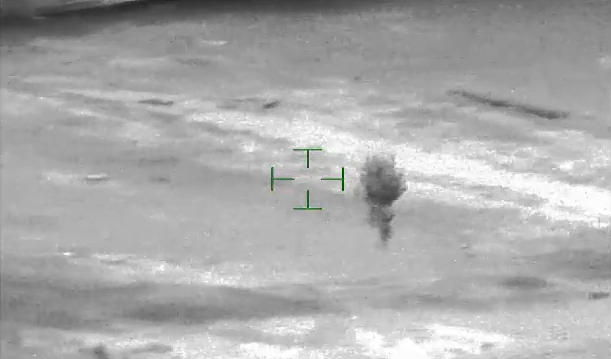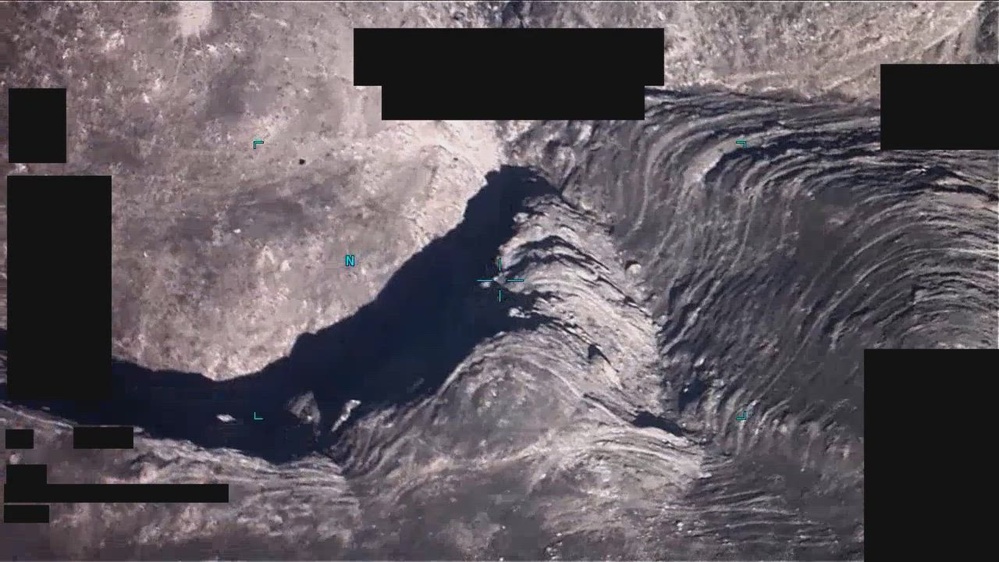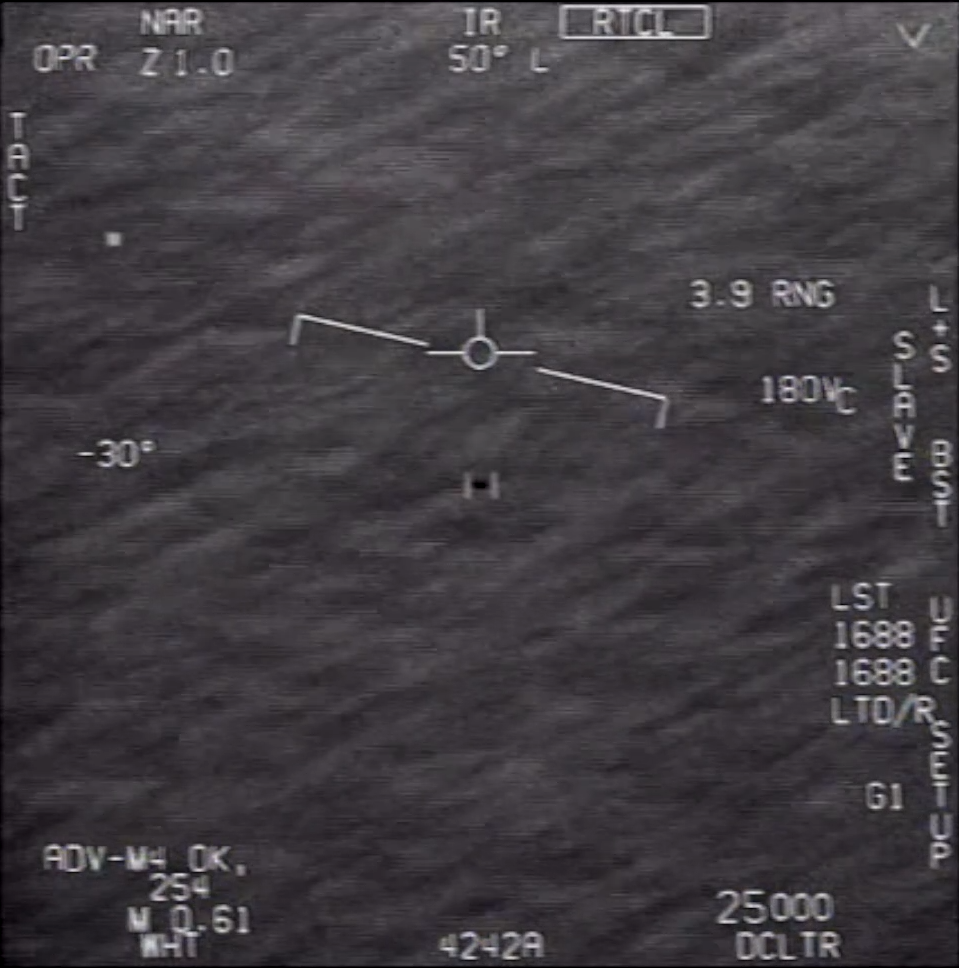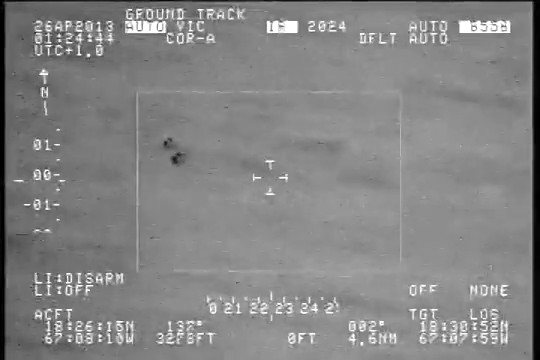
On the evening of April 26, 2013, a thermal infrared camera aboard a U.S. Customs and Border Protection (CBP) DHC-8 aircraft captured video footage of an unidentified aerial phenomenon near Aguadilla, Puerto Rico. The aircraft was conducting a standard border patrol and drug interdiction mission over the Rafael Hernández Airport area and the northwestern coastal waters of Puerto Rico when the incident began.
The thermal sensor — a fixed FLIR (Forward-Looking Infrared) system used routinely by CBP for nighttime surveillance — detected an object moving at low altitude over the airport runway threshold and coastal terrain. The object initially appeared as a single heat source traveling at a speed inconsistent with conventional aircraft in that configuration, with no visible exhaust plume, rotors, or other identifiable propulsion signatures in the infrared band.
As surveillance continued and the camera tracked the object out over the coastline and open ocean, the footage appears to show the object splitting into two distinct heat sources — one of the most debated features of the recording. The two apparent objects then continued moving before one or both appeared to enter the surface of the ocean and subsequently re-emerge, behavior captured in the thermal imagery and described by analysts as transmedium movement across the air-water boundary.
The entire event was recorded over approximately three minutes and covers a roughly two-mile course from the airport area out over open water. Independent analysts later estimated the object's speed at between 60 and 90 miles per hour based on frame analysis and known reference distances, though these calculations carry uncertainty due to unknowns in altitude and camera parameters.
The footage was not initially released publicly by the U.S. government. It came to light through the Scientific Coalition for UAP Studies (SCU), a group of credentialed researchers who obtained a copy and published a detailed 161-page technical analysis in 2015. The video was later acknowledged by government officials and subsequently included in AARO's publicly released evidence archive.
The Puerto Rico Objects video was reviewed by the All-domain Anomaly Resolution Office (AARO) as part of its comprehensive audit of historical UAP cases. The case was presented during congressional briefings in 2023 as an example of a legacy UAP incident exhibiting multi-domain object behavior — specifically, the apparent transition of an aerial object into an aquatic environment, which falls directly within AARO's transmedium research mandate.
Prior to AARO's involvement, the video received significant independent scientific scrutiny from the Scientific Coalition for UAP Studies. Their 161-page technical report applied photogrammetry, frame-by-frame speed analysis, and thermal signature assessment to the footage. SCU analysts concluded that the object exhibited behavior inconsistent with any known conventional aircraft, balloon, or natural phenomenon, specifically highlighting the apparent water entry and re-emergence as particularly anomalous.
U.S. Customs and Border Protection, as the originating agency that captured the footage, conducted an internal review. CBP has not publicly disclosed the findings of that review. The agency declined to formally classify or identify the object, and the original flight crew reports and full instrument data from the DHC-8 have not been released to the public.
AARO's formal assessment of the Puerto Rico case has been cautious. Officials acknowledged the unusual characteristics visible in the footage but noted that without access to the complete sensor package data, radar records, and meteorological information from that evening, a definitive identification could not be made. The object's apparent splitting was noted as a potential optical artifact of the thermal imaging system, though this explanation has not been conclusively demonstrated by any publicly released analysis.
The case is notable for the involvement of non-governmental scientific investigators who performed rigorous technical analysis in the absence of official disclosure. Their methodology — including speed triangulation using runway markings as known reference points — established a framework for independent UAP analysis that has influenced subsequent research efforts in the field.
The official conclusion from AARO and the U.S. government is that the Puerto Rico Objects incident remains unidentified. No conventional explanation has been publicly offered that adequately accounts for the combination of observed behaviors — transmedium movement, object splitting, and apparent submersion and re-emergence — visible in the authenticated thermal footage.
Independent researchers, particularly the SCU analysts, have been more definitive in their conclusions, stating that the object's measured performance characteristics place it outside the envelope of any known aerial or aquatic vehicle. The SCU report remains one of the most technically detailed open-source analyses of any UAP case in the modern era and has not been formally rebutted by any government scientific body.
The Puerto Rico case has contributed meaningfully to the emerging concept of "transmedium" UAP — objects apparently capable of operating across both air and water environments. This concept has gained official traction: congressional UAP legislation and AARO's mandate explicitly incorporate transmedium capabilities as a designated research focus, making this case directly relevant to the program's core investigative agenda.
The case remains in AARO's active archive and has not been resolved or closed. Its continued unresolved status, combined with the quality of the sensor data, makes it one of the most consequential unsolved UAP cases in the modern era and a frequent reference point in discussions of what phenomena AARO's investigation program is actually meant to address.
- Q.01Was the apparent splitting of the object a real physical event or a FLIR sensor artifact? Thermal imaging systems can produce optical artifacts including halation, ghosting, and bloom effects. Whether the visible split represents two distinct objects or an imaging artifact of the sensor system has not been definitively resolved by any publicly released technical analysis.
- Q.02Did radar systems at Rafael Hernández Airport or the CBP aircraft detect the object? The airport maintains radar surveillance, and the DHC-8 aircraft carries its own systems. Whether either registered a contact corresponding to the object in the thermal video — and what that contact's characteristics were — has not been disclosed publicly.
- Q.03What were the precise speed and altitude of the object throughout the encounter? Independent speed estimates range widely depending on assumed altitude. Without confirmed altitude data from the sensor platform logs, speed calculations carry large uncertainty margins that affect all performance assessments and complicate any comparison to known vehicles.
- Q.04Is there subsurface sonar or maritime data corroborating the water entry? If the object entered the ocean as the video suggests, naval or coast guard sonar or maritime patrol data from that area and time might provide independent evidence of a submerged contact. Whether such data exists or was reviewed by CBP investigators is unknown.
- Q.05Were the CBP flight crew formally interviewed and their real-time observations documented? The crew of the DHC-8 had live visibility of the sensor feed and may have observed the object directly. Formal witness statements would provide important context that sensor data alone cannot supply.
- Q.06What does the Puerto Rico case mean for the emerging transmedium UAP hypothesis? This case is the most-cited evidence for craft capable of operating seamlessly across both aerial and aquatic environments — a category that existing military doctrine and aerospace science have no established framework to explain. If the transmedium behavior is validated by further investigation, it would represent a fundamental technological discontinuity from any known human or natural system, making this one of the most consequential UAP cases for the broader scientific and national security debate.