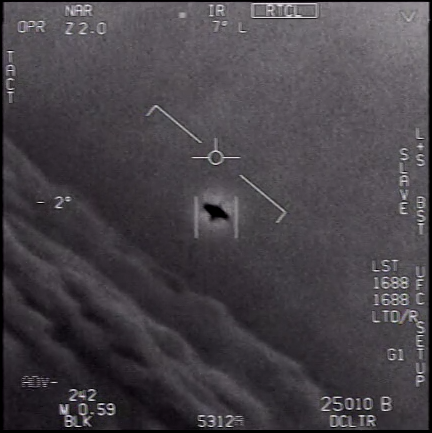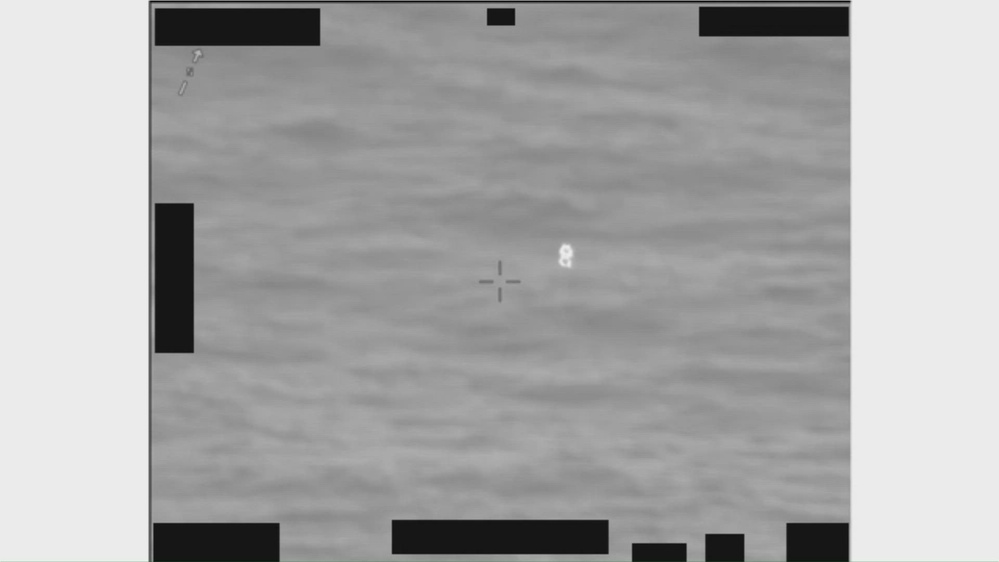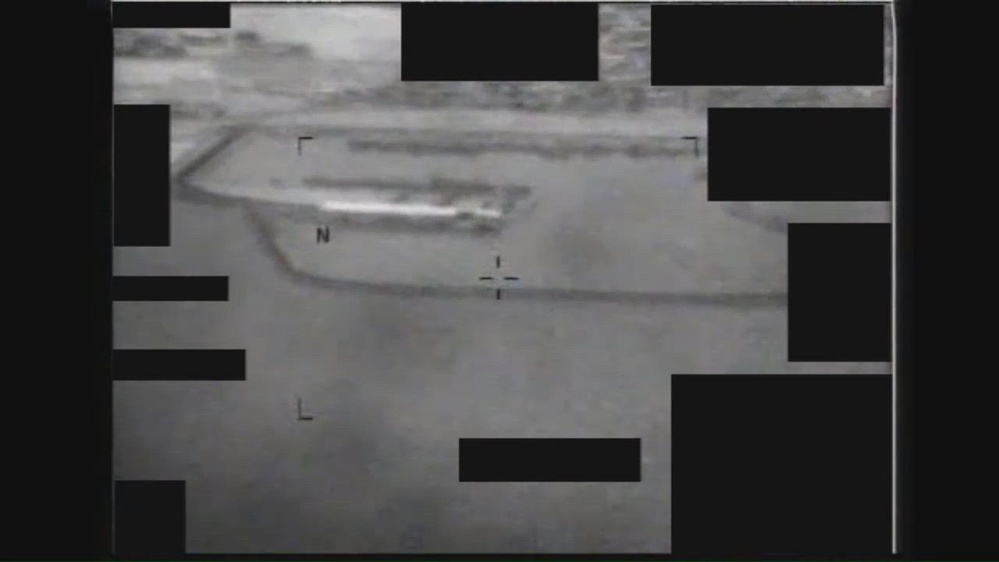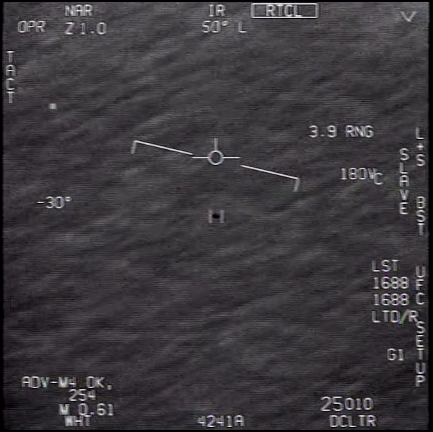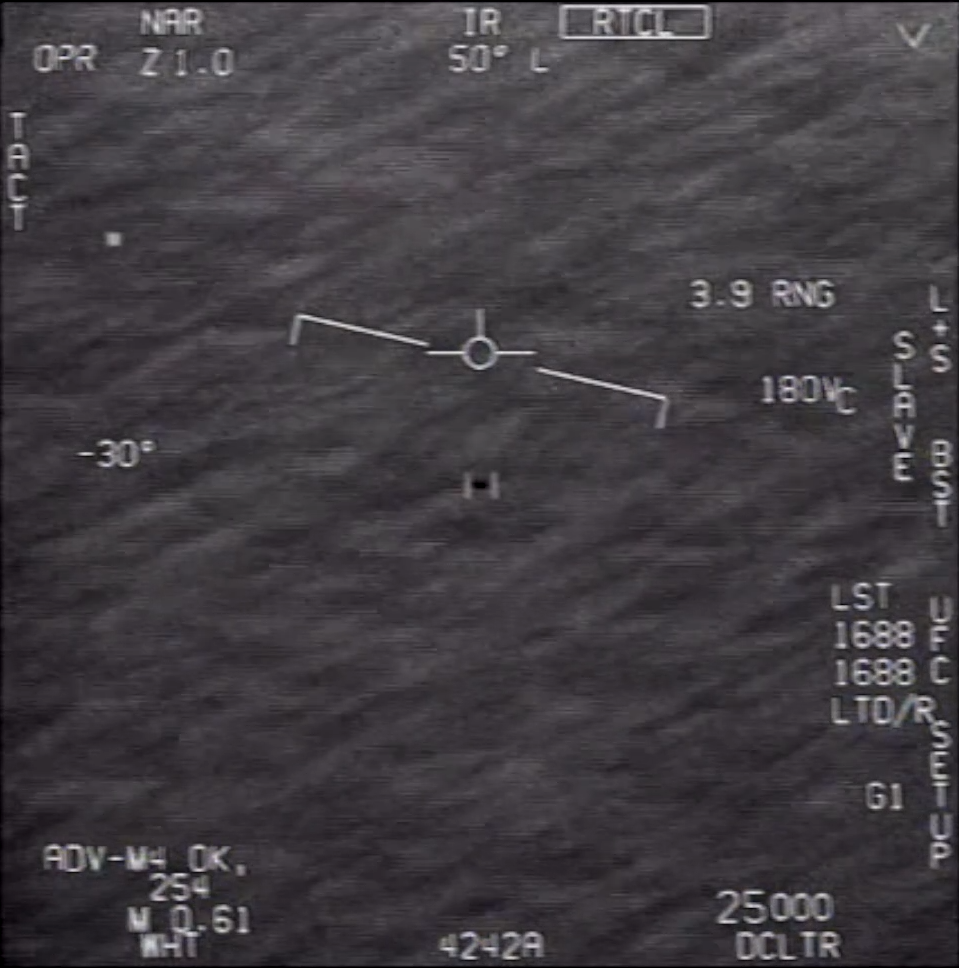
On January 21, 2015, an F/A-18 Super Hornet crew from the aircraft carrier USS Theodore Roosevelt was conducting a training mission over the Atlantic Ocean off the eastern coast of the United States near Florida when they observed and filmed an unidentified aerial object using the aircraft's Advanced Targeting Forward Looking Infrared pod. The resulting footage, known as the Go Fast video, is one of three officially authenticated military UAP videos released to the public by the U.S. Department of Defense and is one of the core exhibits in the modern era of government UAP disclosure.
The video shows an object traveling at low altitude above the ocean surface, tracked by the ATFLIR pod mounted on the F/A-18. The object appears as a bright, roughly spherical shape against the dark ocean background, moving rapidly across the sensor's field of view. The pilots on the flight deck can be heard reacting to the object with surprise, commenting on its speed and their inability to immediately identify it as any known aircraft type. The encounter was brief and the crew maintained visual and sensor contact for only a limited period before the object moved beyond effective tracking range.
The encounter took place during a period of sustained anomalous aerial activity reported across the USS Theodore Roosevelt carrier strike group operating in the same area of the Atlantic. Multiple F/A-18 crews from the Roosevelt reported encounters with unidentified objects during the 2014 to 2015 operational period, and the Go Fast video is one of several recorded clips from this broader wave of sightings associated with the Roosevelt strike group. These encounters collectively represent one of the most extensively documented sustained military UAP event series in the modern record prior to the 2004 Nimitz encounter being superseded in the public discourse by post-2017 disclosures.
The object's apparent speed, as suggested by its motion across the sensor frame, contributed to the name given to this video by the pilots and subsequently adopted in public accounts. However, detailed photogrammetric analysis of the footage performed after its public release produced a substantially different picture of the object's actual performance characteristics. Independent analysts including Mick West examined the footage and concluded that the object's apparent extreme speed was an artifact of the sensor geometry and the aircraft's own heading and altitude, and that the object may in fact have been moving relatively slowly rather than at the apparent high velocity suggested by casual viewing of the clip.
The Go Fast video was one of three clips originally leaked to the Stars Academy of Arts and Science in 2017 and subsequently published by the New York Times in its landmark December 2017 investigative article revealing the existence of the Pentagon's Advanced Aerospace Threat Identification Program. The Navy officially authenticated all three videos in September 2019, confirming they were genuine recordings of unidentified aerial phenomena that had never been cleared for public release. This authentication placed the Go Fast footage in the small category of officially confirmed military UAP evidence in the public record.
The Go Fast video was reviewed by the Pentagon's Advanced Aerospace Threat Identification Program and its successor organizations including the Unidentified Aerial Phenomena Task Force and the All-domain Anomaly Resolution Office. AARO included the Go Fast footage in its official archive of authenticated military UAP videos and presented it as part of the broader public evidence record released in congressional briefings beginning in 2022 and 2023.
Independent technical analysis of the video has been extensive and has produced significantly different conclusions about the object's actual speed compared to its apparent speed in the footage. Using the ATFLIR pod's known field of view parameters, the aircraft's recorded altitude, airspeed, and heading, and the object's observable angular rate of change in the footage, independent analysts calculated that the object's ground speed was likely in the range of a relatively slow moving aerial vehicle rather than at the extreme velocity implied by the "Go Fast" designation. This analysis, if correct, substantially reduces one of the most dramatic claimed characteristics of the encounter.
The official investigation has not publicly released a comprehensive technical analysis of the object's calculated speed derived from the sensor telemetry data recorded during the encounter. The ATFLIR pod records targeting data including range, elevation, and azimuth that would allow a precise reconstruction of the object's actual velocity. Whether this data was analyzed and what it showed has not been included in any publicly released AARO assessment of the footage, leaving the core performance question unresolved in the official record.
AARO's assessment of the Go Fast video as part of its broader review of the Roosevelt strike group encounters has been cautious. The agency has characterized the object as unidentified without offering a definitive conventional explanation, while also stopping short of endorsing the most dramatic performance claims associated with the footage. The institutional handling of this video reflects the broader challenge facing AARO in assessing single sensor clips without access to contemporaneous corroborating data streams from radar and other platforms that were present during the encounters.
The Roosevelt strike group encounters as a whole, including the Go Fast incident, prompted the Navy to revise its UAP reporting guidelines for aircrew in 2019, creating formal channels for pilots to report anomalous aerial contacts without the professional stigma that had previously discouraged disclosure. This policy change, directly traceable to the public attention generated by the Roosevelt encounter videos, represents one of the most concrete institutional outcomes of the modern era of military UAP disclosure.
The official conclusion from AARO and the Navy is that the object in the Go Fast video remains unidentified. No conventional explanation has been formally offered that accounts for the crew's reaction during the encounter or the object's visual characteristics in the authenticated footage. The video's official status as a genuine record of an unidentified aerial phenomenon has never been withdrawn.
The independent analysis suggesting the object may have been moving slowly rather than at extreme speed is a significant point of contention in the case's evidentiary assessment. If the photogrammetric analysis is correct, the Go Fast object's most dramatic apparent characteristic is an optical artifact of the sensor geometry rather than an actual performance feature of the object. This would not resolve the object's identity but would substantially change its significance as evidence of extraordinary aerial performance.
The video remains important in the UAP record primarily because of its official authentication rather than its specific content. The Navy's 2019 confirmation that three specific video clips were genuine, unclassified military sensor recordings of unidentified phenomena represented an unprecedented institutional acknowledgment. The Go Fast footage, as one of those three authenticated clips, is permanently part of the official military UAP evidence record regardless of ongoing debates about the object's actual speed.
The broader context of the Roosevelt strike group encounters, of which Go Fast is one element, is likely more significant than any individual clip. The sustained pattern of anomalous aerial contacts reported by multiple professional aircrew across an extended operational period represents a category of military UAP experience that neither the Navy nor AARO has produced a satisfactory comprehensive explanation for, and that continues to inform the institutional and legislative response to the UAP phenomenon in the years following.
- Q.01What does the ATFLIR pod's own targeting telemetry show about the object's actual ground speed? The pod records range, azimuth, and elevation data throughout a tracking engagement. A precise velocity calculation derived from this onboard telemetry would definitively resolve the debate between the apparent high speed suggested by the footage and the lower speed calculated by independent photogrammetric analysis. Whether this data was retrieved and analyzed has not been addressed in any public AARO release.
- Q.02Was radar contact established with the object from the aircraft or from the Roosevelt's onboard systems? The carrier strike group operates extensive radar surveillance covering the airspace around the formation. Whether any radar facility aboard the Roosevelt or its escort vessels tracked a contact corresponding to the Go Fast object at the time of the visual and FLIR acquisition has not been publicly established.
- Q.03How does the Go Fast object relate to the broader pattern of anomalous contacts reported by Roosevelt crews in 2014 and 2015? Multiple aircrew from the Roosevelt filed reports of similar encounters during this operational period. Whether the Go Fast object is the same category of phenomenon as the others reported, whether it is the same specific object seen on other occasions, and what the pattern analysis of all Roosevelt encounter reports reveals about the origin and nature of the phenomenon has not been publicly synthesized in any AARO report.
- Q.04What were the atmospheric and sea state conditions at the time of the encounter? Low altitude objects over the ocean surface can in some circumstances be associated with atmospheric ducting, sea surface reflections, and other optical or radar propagation anomalies. Whether the meteorological and oceanographic conditions during the Go Fast encounter were reviewed to assess these possibilities has not been established in public accounts of the official analysis.
- Q.05Were other aircraft in the training area at the time of the encounter that could have been the source of the observed object? Military training operations involve multiple aircraft in defined airspace blocks. Whether a complete deconfliction review was performed to rule out all friendly aircraft operating in the relevant airspace at the time of the contact has not been documented in the publicly available investigation record.
- Q.06What is the collective significance of the Roosevelt strike group UAP encounters for understanding the current operational threat environment? The sustained, multi crew, multi encounter pattern of anomalous aerial contacts during the Roosevelt's 2014 to 2015 operational period represents a category of military UAP experience that has never been fully explained. Whether these encounters reflect adversarial surveillance technology, an uncharacterized natural phenomenon concentrated in that area of the Atlantic, or something else entirely has profound implications for naval operational security and airspace management. The Go Fast video is a single frame within this larger unresolved pattern, and the pattern as a whole remains one of the most consequential unsolved questions in AARO's active investigative portfolio.