On the evening of August 25, 1951, four professors from Texas Technological College in Lubbock, Texas were sitting together in a backyard when they observed a formation of softly glowing bluish white lights pass silently overhead in a curved or semicircular arc. The witnesses were Dr. W.I. Robinson, a professor of geology; Dr. A.G. Oberg, a professor of chemical engineering; Professor W.L. Ducker, head of the petroleum engineering department; and Dr. E.L. George, a professor of physics. Their professional backgrounds as scientists with strong observational training made them among the most credentialed witness group in early UFO history, and they took their observation seriously enough to begin systematic nightly sky watches to document further appearances.
Their patience was rewarded quickly. Over the following weeks, the same or similar formations of lights passed over Lubbock on multiple occasions, always traveling from north to south, always silent, and always displaying the characteristic semicircular arrangement of individual light points that distinguished them from conventional aircraft formations or meteor showers. The professors made careful observations on each occurrence, noting timing, compass bearing, estimated angular velocity, and the arrangement and number of individual light sources. Their systematic approach produced an unusually thorough descriptive record of a recurring unexplained phenomenon.
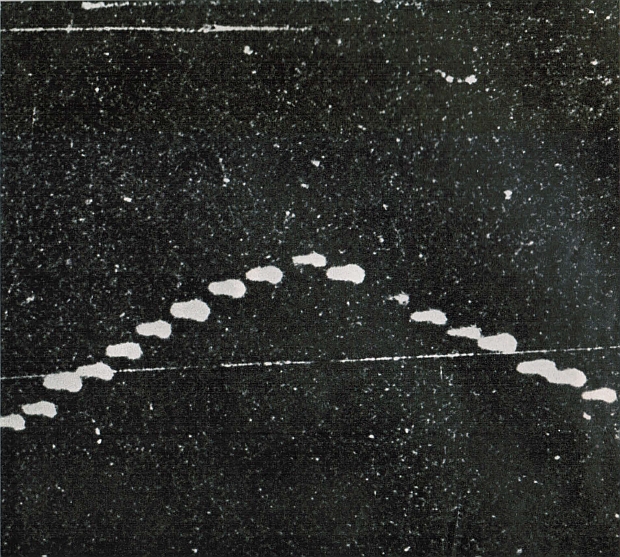
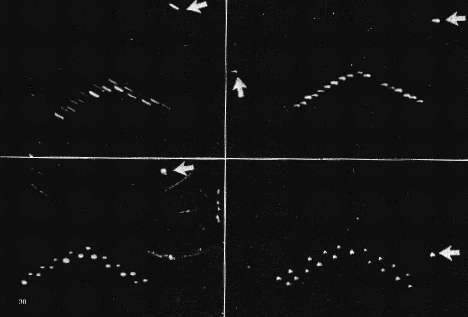
The photographs that brought the Lubbock Lights to national attention were taken by Carl Hart Jr., a 19 year old freshman at Texas Tech who had heard of the professors' sightings and decided to set up his camera in his backyard with a long lens on a tripod on the chance the lights would return. On the night of August 30, 1951, his patience was rewarded. The lights passed overhead twice within a short period and Hart captured a series of five photographs showing the formation clearly. The photos were published in Life Magazine and became among the most examined UFO photographs in Project Blue Book's history.
Separate from and simultaneous with the Lubbock observations, radar operators at Reese Air Force Base near Lubbock detected an unknown object traveling at extreme speed overhead on the same night as one of the professors' sightings. The object was clocked at approximately 900 miles per hour at an altitude of about 13,000 feet, which in 1951 significantly exceeded the speed of any aircraft in the U.S. inventory. A witness in Albuquerque, New Mexico also independently reported a large dark object with lights along its trailing edge on approximately the same date, appearing to corroborate that the Lubbock phenomenon extended beyond a purely local occurrence.
The simultaneity of the professors' sightings, Hart's photographs, the Reese AFB radar contact, and the independent Albuquerque report created a convergence of independent evidence streams that distinguished the Lubbock Lights from most early UFO cases and placed it among the strongest multi source cases in Project Blue Book's archive. The photographs in particular were subjected to the most extensive photographic analysis that Blue Book ever applied to a civilian UAP photograph set.
Project Blue Book assigned Edward Ruppelt, the program's director and one of the most thorough and intellectually honest investigators in the program's history, to personally investigate the Lubbock Lights case. Ruppelt traveled to Lubbock, interviewed the professors and Carl Hart Jr., reviewed the photographs, and examined the Reese AFB radar data. He assessed the Texas Tech professors as exceptionally credible witnesses and the Hart photographs as apparently genuine, describing the Lubbock case in his subsequent memoir as one of the most perplexing and significant in Blue Book's files.
The Hart photographs were subjected to detailed photographic analysis by Blue Book's technical staff and by outside consultants. The analysis examined the photographs for evidence of double exposure, darkroom manipulation, or optical artifacts that might account for the light pattern. The analysis concluded that the photographs appeared genuine and that the light formation visible in them did not match any known aircraft configuration or natural phenomenon. The images showed a clear semicircular arrangement of individual bluish white lights that was internally consistent across the five frames and geometrically consistent with the professors' independent visual descriptions.
The alternative explanations considered by Ruppelt and Blue Book analysts included migrating birds reflecting city lights, a unique atmospheric optical phenomenon, a classified American aircraft, and outright hoax. The bird hypothesis, which Ruppelt personally explored in detail, proposed that a flock of plovers flying south could reflect Lubbock's street lights and appear as a formation of glowing dots. Ruppelt found this explanation plausible for some of the visual observations but noted significant difficulties in reconciling it with the Hart photographs and the Reese AFB radar data, which birds would not produce.
The classified aircraft hypothesis was carefully considered given the Cold War context and the proximity of Reese AFB, a major Strategic Air Command installation. Blue Book investigators made inquiries about classified programs and were told that no experimental aircraft was responsible for the Lubbock observations. The speed recorded on Reese's radar, approximately 900 miles per hour, was consistent with aircraft technology under development in 1951 but ahead of anything then in operational service, making the classified aircraft explanation neither confirmable nor definitively excludable.
Ruppelt ultimately produced a conclusion for the Lubbock case that acknowledged the case's genuine difficulty. He identified the visual observations of the Texas Tech professors as likely having a conventional natural explanation while treating the Hart photographs and the radar data as more resistant to that explanation. His assessment that the case had multiple distinct components requiring potentially different explanations was one of the more nuanced conclusions in Blue Book's history and reflected his genuine uncertainty rather than the program's more typical posture of forcing cases into conventional categories.
Project Blue Book's official final disposition of the Lubbock Lights case was listed as unknown for the Hart photographs and the radar data, while the professors' visual observations were eventually assigned the bird reflection explanation in the program's final records. This split disposition reflects the genuine analytical difficulty of the case: the bird hypothesis plausibly accounts for some elements while failing to explain others, and Blue Book was unwilling to force all components of the case into a single conventional category.
The Lubbock Lights hold a distinguished place in UFO history as one of the very few cases in which a recurring phenomenon was repeatedly observed by a group of credentialed professional scientists who undertook systematic documentation. The Texas Tech professors' willingness to treat their observations as a genuine scientific question worthy of careful documentation, rather than dismissing them as anomalous and moving on, produced an evidentiary record of unusual quality for the early 1950s.
The Hart photographs remain among the most discussed in the UAP photograph archive. Unlike many purported UFO photographs, they were taken by a witness who had specifically set up equipment in anticipation of the phenomenon's return based on prior reports, giving them a credible provenance. The consistency between the photographic record and the independent visual descriptions from the professors strengthens both lines of evidence and distinguishes this case from photographs produced without corroborating witness testimony.
The Lubbock case illustrates the recurring challenge of cases with multiple simultaneous evidence streams whose conventional explanations diverge. When the best available explanation for visual observations fails to account for radar data and photographs from the same event, no single conventional explanation can be accepted as fully satisfactory. This situation, common to many of the strongest UAP cases across all eras, reflects the fundamental limitation of investigations that must rely on incomplete data and cannot conduct controlled experiments to test competing hypotheses.
- Q.01Can the Hart photographs be definitively authenticated using modern digital forensic methods? The original photographic negatives, if they still exist and are accessible, could be subjected to modern densitometric and digital analysis that was not available to Blue Book investigators in 1951 and 1952. Such analysis could potentially detect evidence of manipulation or confirm the photographs' authenticity with a much higher degree of certainty than was achievable with period technology.
- Q.02Does the Reese AFB radar contact from the same period represent the same phenomenon as the visual observations? The 900 mile per hour radar track recorded at Reese AFB is difficult to reconcile with the bird reflection hypothesis that Ruppelt found most plausible for the visual observations. Whether the radar contact and the visual formation were the same object, the same category of phenomenon, or entirely unrelated events occurring coincidentally in the same geographic area and time period has never been definitively established.
- Q.03What did the Albuquerque independent witness observe, and how does it relate to the Lubbock phenomenon? An independent report from Albuquerque of a large dark object with lights along its trailing edge was received around the same time as the Lubbock peak activity period. Whether this report was systematically investigated, what the witness's qualifications and reliability were assessed as, and whether the described object's characteristics are consistent with the Lubbock formations has not been established in publicly available Blue Book records.
- Q.04Were the professors ever given the opportunity to view Hart's photographs alongside their own observational records to assess consistency? The consistency between the professors' independent visual descriptions and Hart's photographs is one of the case's most important evidentiary features. Whether Blue Book investigators formally conducted a structured comparison in which the professors reviewed the photographs and assessed them against their own observations, and what their assessment was, is not established in the publicly available case documentation.
- Q.05What classified military programs were operating in the vicinity of Lubbock in late 1951? Reese AFB was a Strategic Air Command installation with significant classified activity in the early Cold War period. A comprehensive assessment of what classified aircraft, balloon, or drone programs were operating in the area in August and September 1951 has never been published in any declassified source, leaving the classified technology hypothesis neither confirmed nor definitively excluded.
- Q.06What is the significance of the Lubbock Lights as a precedent for scientist led UAP observation? The Texas Tech professors represent one of the earliest documented instances of professional scientists treating a UAP observation as a legitimate phenomenon worthy of systematic scientific documentation. Their approach foreshadowed the methodology advocated by researchers including Dr. James McDonald and Dr. J. Allen Hynek in subsequent decades, and anticipated the scientific rigor now embodied in programs like the Galileo Project. The question of whether the scientific community's long reluctance to engage seriously with UAP reports, following the professional and reputational pressures of the Blue Book era, has resulted in the loss of decades of potentially productive scientific data is one of the most consequential meta questions in the entire history of UAP research.