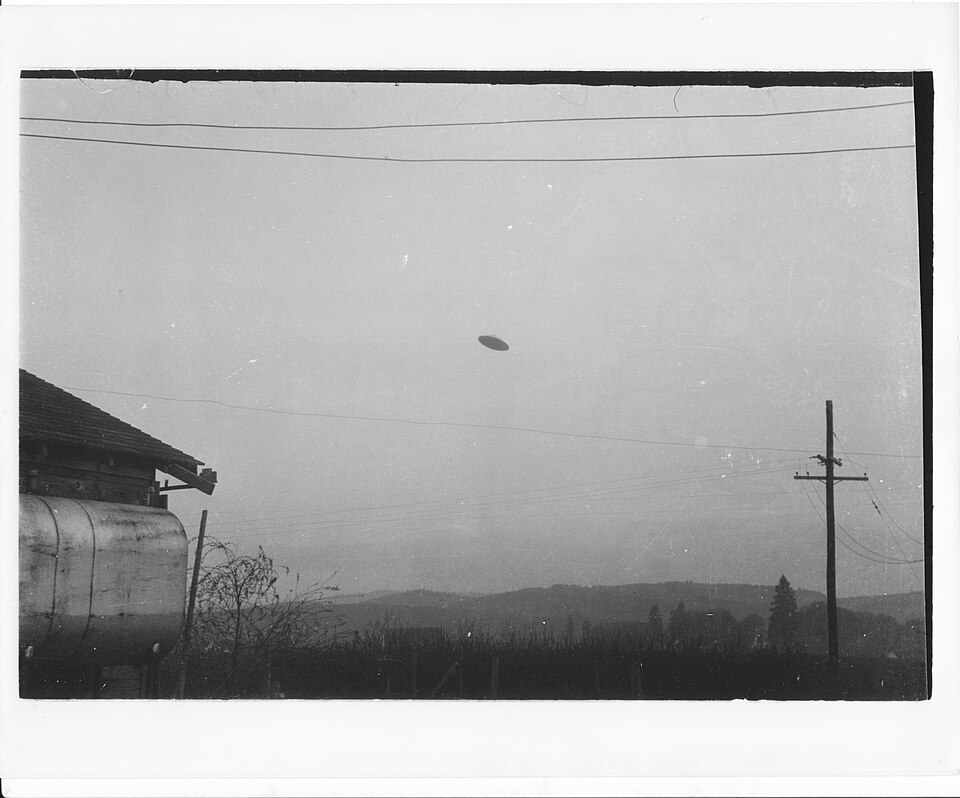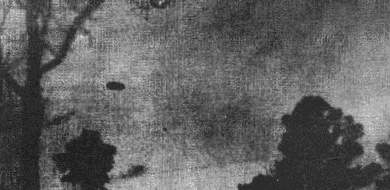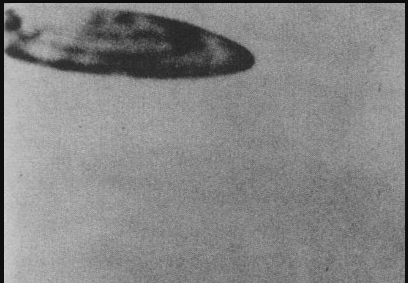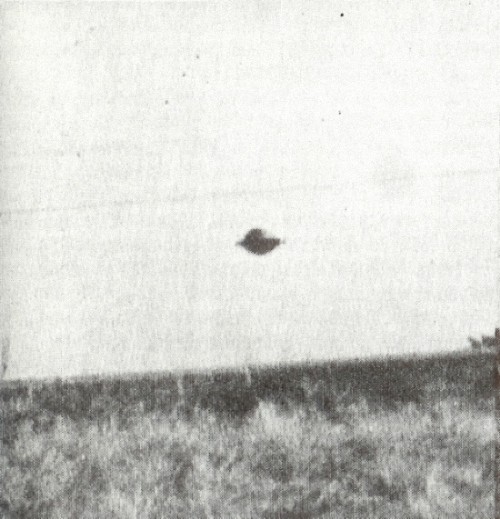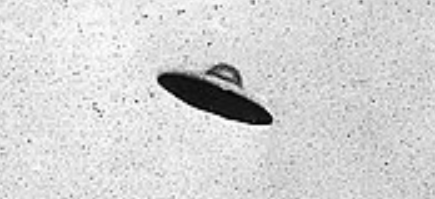
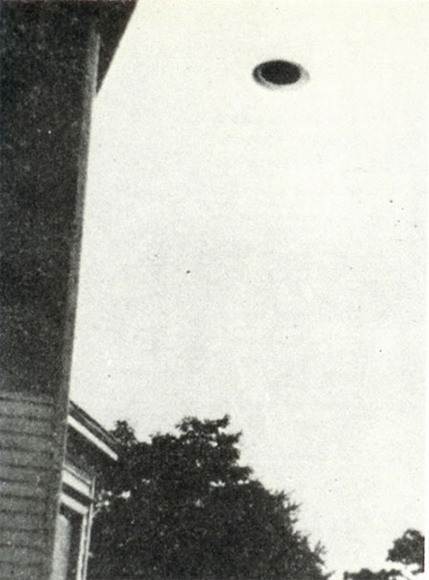
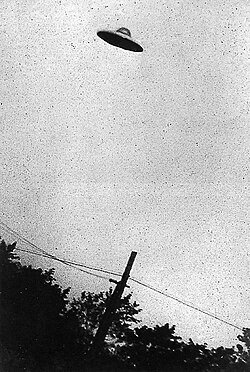
On the evening of July 29, 1952, George Stock, a resident of Passaic, New Jersey, photographed an unusual disc shaped object maneuvering in the sky above his neighborhood. Stock used a box camera to capture five photographs of the object as it moved, hovered, and tilted at different angles over a period of a few minutes before departing. The photographs show a saucer or discus shaped object viewed from slightly below, with a bright or luminous underside and a darker upper surface visible in some of the frames as the object tilted to reveal its profile. The images remain among the clearest disc shaped UAP photographs taken during the intense summer 1952 UFO wave that swept the eastern United States.
The date of the Passaic sighting is particularly notable in the context of that summer's events. July 29, 1952 falls precisely ten days after the first Washington D.C. radar incidents of July 19 to 20 and one day after the second, even more dramatic Washington incidents of July 26 to 27. The summer of 1952 represented the most concentrated and broadly reported wave of UAP activity in American history up to that point, with hundreds of reports pouring into Project Blue Book from across the country and the phenomenon generating national press coverage and public concern at an unprecedented level.
Stock described the object as silent, with a metallic appearance and a flat profile seen from a slight angle below. He stated it moved smoothly without any of the sound or visual signature of conventional aircraft and that its movements included hovering, banking, and accelerating in a manner unlike any aircraft he had observed. The multiple photographs provide a sequence showing the object at different orientations, which constrains the possible interpretation of the images as a single photograph of a fixed object taken from a single angle and broadens the evidentiary basis of the encounter record.
The photographs were submitted to the Air Force and reviewed as part of Project Blue Book's processing of the enormous caseload generated by the summer 1952 wave. The Passaic photographs were among dozens of photograph sets received during this period as Americans who had heard about the Washington incidents and the national media coverage responded to unusual sightings with their cameras. Despite the volume of photograph submissions in this period, only a small number from the summer 1952 wave survived the routine Blue Book analysis with their evidentiary significance intact, and the Passaic images are among those that researchers have continued to study.
The Passaic images also appeared in early civilian UAP research publications and were among the photographs reviewed by private researchers in the years following their Air Force submission. Their appearance in the broader photographic literature gave them a distribution and discussion history that most Blue Book photograph cases did not receive, and this broader exposure contributed to their retention in the research record beyond the program's closure in 1969.
Project Blue Book's investigation of the Passaic photographs was conducted during one of the program's most overwhelmed periods. The summer 1952 wave generated more cases in a shorter period than at any other point in the program's history, and investigators were processing reports at a rate that made thorough individual case treatment difficult. The Passaic photographs received standard processing rather than the priority treatment given to cases like the Lubbock Lights or the Washington radar incidents, and the investigation record is correspondingly less detailed than for those higher priority cases.
The photographic analysis applied to the Passaic images focused on the standard questions of whether the images showed evidence of darkroom manipulation, whether the object's characteristics were consistent with a known aircraft type viewed from an unusual angle, and whether the lighting and shadow conditions in the photographs were internally consistent with a genuine outdoor scene. The analysis did not produce a definitive identification of the object as any known type, and the case was designated as unidentified in Blue Book's records, consistent with the program's treatment of many photograph cases from the 1952 wave that could not be convincingly assigned to a conventional category.
The object's shape and orientation in the Passaic photographs has been compared to several known conventional objects by skeptical analysts over the years, including various automobile hubcap models, which were a common proposed explanation for disc shaped UAP photographs in the 1950s. The hubcap hypothesis applied to the Passaic images requires that a hubcap be thrown or suspended in a way that produces the smooth, level flight profile visible across multiple sequential photographs, a requirement that is substantially more difficult to satisfy for a sequence of images than for a single photograph.
The broader context of the summer 1952 wave gives the Passaic case additional interpretive weight. The concentration of reports from across the country, many from trained observers and some with independent corroboration, and the simultaneous radar detections in Washington D.C., suggests an elevated level of genuine anomalous aerial activity during this period rather than a coincidental clustering of misidentifications. Whether the Passaic photographs document part of that same broader wave of genuine activity or represent an independent coincidental hoax or misidentification during a period of heightened public attention to the subject is a question that the photographs alone cannot answer.
The Robertson Panel, which convened in January 1953 and addressed the broader problem of the 1952 wave including the Washington incidents, did not specifically address the Passaic photographs in its publicly available deliberations. The panel's focus on the Great Falls and Tremonton films as the primary photographic and film evidence meant that still photography cases from the 1952 wave, including Passaic, received less institutional attention than the moving image evidence despite potentially being as significant in content.
Project Blue Book's official designation for the Passaic photographs was unidentified, meaning that the investigation was unable to assign the object to any known conventional category. This designation was consistent with the treatment of many 1952 wave photograph cases but should be understood in the context of the program's overwhelmed processing capacity during that period, which meant that the absence of a conventional explanation reflected partly a genuine analytical failure to identify the object and partly a resource limitation that prevented thorough investigation.
The multiple photograph sequence is the most distinctive evidentiary feature of the Passaic case and the primary reason it has remained in the research literature beyond the period of initial reporting. A sequence of images showing an unusual object at different orientations and positions is substantially harder to fabricate with period technology than a single photograph, and the internal consistency of the sequence provides a degree of self corroboration that single images lack. Whether this consistency reflects a genuine encounter or an elaborate multi image fabrication has not been formally resolved.
The Passaic photographs document a sighting that occurred during one of the most consequential periods in American UAP history, ten days after the first Washington radar incidents and during the peak of the summer 1952 wave that provoked the largest peacetime Pentagon UAP press conference in history. Whether the New Jersey sighting is connected to the broader pattern of eastern seaboard UAP activity during that period or is an independent event is a question that neither the photographs nor the Blue Book investigation record addresses.
The Passaic case illustrates the general problem of mid tier photograph cases in the historical UAP record: evidence that is of sufficient quality to survive initial skeptical analysis without being explained, but not of sufficient quality or investigative priority to attract the sustained detailed analysis that would either authenticate it convincingly or identify a definitive conventional explanation. This middle category constitutes the majority of Blue Book's unresolved photograph cases and represents a substantial archive of evidence whose evidential value has never been fully assessed.
- Q.01How many photographs did George Stock take, and do all of them survive in archive form? Published accounts refer to approximately five photographs. Whether all were submitted to the Air Force, whether all survive in Blue Book's records now held at the National Archives, and whether any higher resolution versions of the images than those appearing in published accounts are accessible to researchers has not been established in recent public accounts of the case.
- Q.02What is the photogrammetric assessment of the object's size based on the angular subtended in the photographs and the known geometry of the scene? The photographs show rooftops and other reference structures in some frames that could be used to constrain the object's apparent angular size. Combined with reasonable assumptions about the distance to those reference objects, a range of possible object sizes at different distances could be derived. Whether such a formal photogrammetric analysis has been applied to the Passaic images with published methodology and results has not been established.
- Q.03Were any other Passaic area residents observing the sky on the evening of July 29, 1952 who might have independently observed the same object? The summer 1952 wave had generated substantial public awareness of UAP activity. Whether any systematic canvass of Passaic area residents was conducted to identify additional witnesses to the object Stock photographed, and whether any such witnesses came forward independently, has not been established in publicly available accounts of the case's investigation.
- Q.04Is there any radar data from the New York or New Jersey area from the evening of July 29, 1952 that might show an anomalous contact in the Passaic area at the time of Stock's photographs? The Washington incidents had produced acute awareness of radar as a corroborating tool for UAP observations. Whether military or civilian radar facilities in the greater New York metropolitan area were operating on that evening and whether their records were reviewed for anomalous contacts in the Passaic area has not been established in publicly available investigation accounts.
- Q.05How does the Passaic object's visual characteristics compare to those reported in other sightings during the same 1952 wave? The summer of 1952 generated hundreds of reports from across the country. Whether the object's shape, apparent size, and behavior as reported by Stock and visible in the photographs are consistent with other well documented reports from the same period, suggesting a common phenomenon, or are distinctive and unlike other contemporaneous reports, has not been addressed in any systematic comparative analysis in the published literature.
- Q.06What would a comprehensive modern reanalysis of all surviving Blue Book photograph cases from the summer 1952 wave reveal about the period? The summer of 1952 was the most intense period of UAP activity in American history to that date, and it generated a large volume of photographic evidence that was processed under severe resource constraints by a program under enormous pressure to produce conventional explanations. A systematic modern reanalysis of all surviving photograph submissions from the June through September 1952 period, applying current digital photographic analysis techniques and freed from the institutional pressures that shaped Blue Book's original assessments, could substantially enrich the evidential picture of what was actually observed and documented during that extraordinary period and would constitute one of the highest value applications of modern analytical tools to the historical UAP record.