Evidence Media
Photographic & Video RecordInitial Report
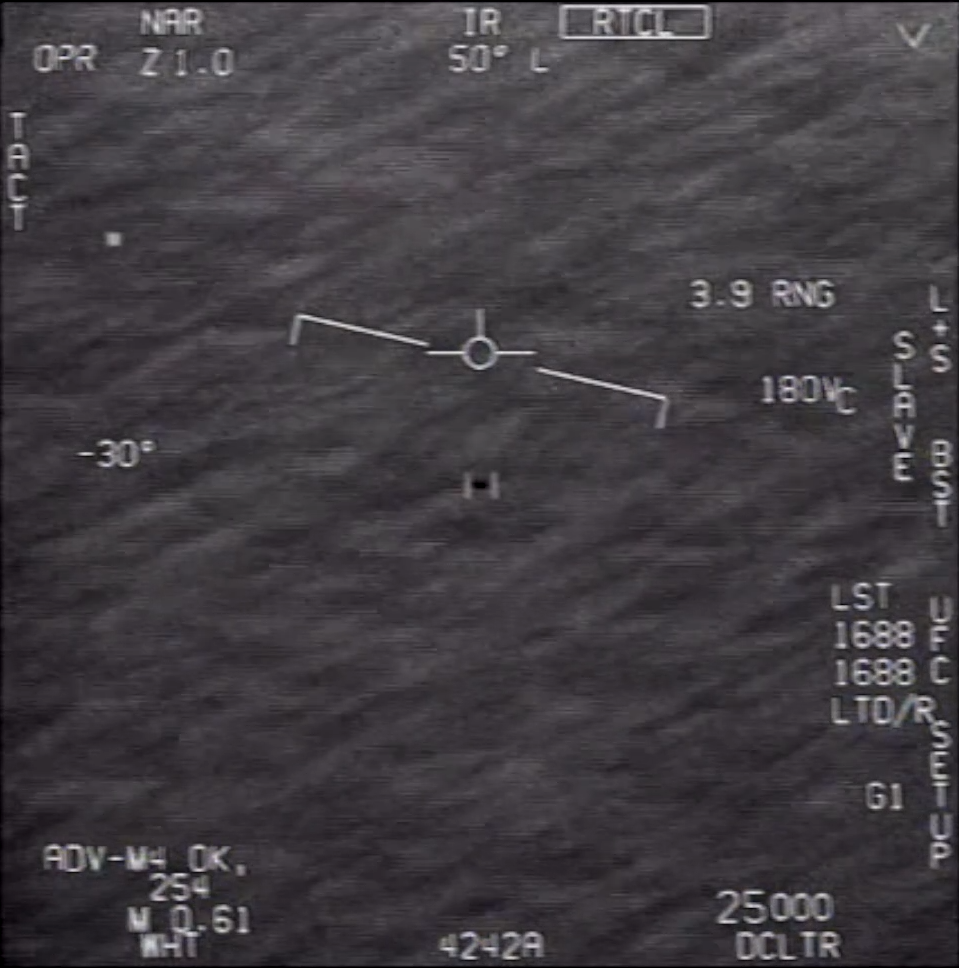
Field ReportDuring January 2015, an F/A-18F Super Hornet crew operating from the USS Theodore Roosevelt during training operations over the Atlantic Ocean off the eastern coast of the United States captured infrared video footage of an unidentified aerial object using the aircraft's ATFLIR targeting pod. The resulting footage, designated the Gimbal video after the pilot's remark about the object appearing to rotate on its axis, is widely assessed as the most analytically significant of the three officially authenticated Navy UAP videos and has been the subject of the most intensive public technical scrutiny.
The Gimbal video shows a dark, roughly disc shaped object moving against a lighter sky background in infrared. The object appears to rotate smoothly and continuously throughout the time it is in the sensor's field of view, with its apparent aspect changing in a manner consistent with axial rotation rather than change of viewing angle from the observing aircraft. The pilots tracking the object can be heard reacting with evident surprise and confusion, with one clearly stating that the object is rotating and another making the observation that has received the most attention in public discussions of the footage: "There's a whole fleet of them."
That comment, in which the pilot refers to additional contacts visible on the aircraft's radar display, is among the most significant elements of the Gimbal encounter. It indicates that the single object visible in the ATFLIR footage was not isolated but was part of a larger group of contacts being tracked on radar simultaneously by the F/A-18's own radar system. The existence of multiple radar contacts in addition to the single filmed object substantially expands the potential scale of the encounter beyond what the video footage alone suggests and places this case in a different evidentiary category from single object sightings without corroborating radar data.
The object's apparent rotation has been the central focus of the most significant technical debate surrounding the footage. Independent analyst Mick West proposed that the rotation effect visible in the Gimbal video is an artifact produced by the ATFLIR pod's own infrared glare suppression optics, which rotate mechanically within the pod housing to manage thermal bloom from strong heat sources. Under this hypothesis, the rotation visible in the video is the pod's internal optics rotating rather than the object itself rotating. This explanation has been debated extensively, with some analysts finding it compelling and others arguing that it does not fully account for the object's visible characteristics throughout the entire video clip.
The Gimbal video was among the three clips originally provided to the Stars Academy of Arts and Science and published by the New York Times in December 2017. It was officially authenticated by the U.S. Navy in September 2019. Of the three authenticated videos, Gimbal received the greatest scientific attention from independent analysts and was described by Luis Elizondo, the former director of the Advanced Aerospace Threat Identification Program, as the single most compelling piece of evidence for genuine anomalous aerial phenomena in the government's possession at the time of his departure from the program.
Official Investigation
Investigation RecordThe Advanced Aerospace Threat Identification Program assessed the Gimbal video as one of its most significant cases prior to the program's transition to the Unidentified Aerial Phenomena Task Force and subsequently to AARO. Luis Elizondo has stated publicly that the Gimbal object exhibited what AATIP analysts called the five observables associated with anomalous aerial phenomena: anti gravity lift, sudden and instantaneous acceleration, hypersonic velocity without a thermal signature, low observability, and trans medium travel. Whether these characterizations are derived from the video footage alone or from additional classified sensor data from the encounter has not been publicly established.
AARO incorporated the Gimbal video into its official evidence archive and presented it in congressional briefings as an example of authenticated military UAP sensor data. The agency's public assessments have been measured, acknowledging the video as genuine and the object as unidentified while declining to endorse the most dramatic interpretations of the footage. AARO has not publicly released a comprehensive technical analysis of the object's rotation that would definitively resolve the debate between those who believe the rotation is a sensor artifact and those who believe it reflects actual object behavior.
The multiple radar contacts mentioned by the pilot during the encounter are among the most important unaddressed evidentiary questions in AARO's public record for this case. The F/A-18's onboard radar data from the encounter, which would show the number, positions, velocities, and track histories of all the contacts visible to the crew at the time, has not been publicly released or described in detail in any official assessment. This data would substantially clarify the scale of the encounter and the performance characteristics of the objects being tracked.
The Navy's revised UAP reporting guidelines, issued in 2019 and partly driven by the public attention generated by the Roosevelt encounters, created formal channels for aircrew to report anomalous contacts without professional penalty. This institutional response, while not constituting an investigation of the Gimbal encounter itself, represented a direct organizational consequence of the case and acknowledged that the encounters experienced by Roosevelt aircrew represented a category of event requiring systematic rather than ad hoc institutional response.
The question of whether the Gimbal object's apparent rotation is genuine physical behavior or a sensor artifact has not been resolved by any publicly released official analysis. The ATFLIR pod's engineering specifications and the full range of its operating modes during the encounter would provide the definitive technical basis for resolving this question, but these specifications have not been publicly released in a form that allows independent verification of either the artifact hypothesis or the genuine rotation hypothesis.
Formal Conclusions
Official DeterminationThe official conclusion is that the Gimbal object remains unidentified. The Navy has confirmed the footage as authentic and no conventional explanation has been officially issued that satisfactorily accounts for all observed characteristics in the video. The object's designation as unidentified in AARO's active case archive has not been changed or resolved in any publicly available document.
The rotation debate represents the most important unresolved analytical question in the case. If the rotation is a genuine property of the object rather than a sensor artifact, it would be one of the most distinctive physical behaviors ever documented in a military UAP encounter and would place the Gimbal object in an essentially unique analytical category. If it is a sensor artifact, the case retains significance as an authenticated video of an unidentified object but loses its most distinctive characteristic. Neither determination has been officially issued.
The pilot's reference to a fleet of objects on radar during the encounter elevates the Gimbal case significantly above the level of a single ambiguous video clip. Multiple simultaneous radar contacts in a naval training area, with no friendly aircraft accounting for them and no subsequent identification provided through deconfliction, represents an operational anomaly of genuine national security significance regardless of the analytical questions about the filmed object's rotation. This radar dimension of the case has received substantially less public attention than the visual footage and remains the least addressed component of the official investigation record.
Luis Elizondo's public characterization of Gimbal as the most compelling UAP evidence he encountered during his tenure directing AATIP carries exceptional institutional weight. As the senior official responsible for the government's classified UAP investigation program, his assessment that this specific footage represented evidence of something beyond known aerospace technology is the closest thing to a senior official determination that has ever been issued about any specific UAP case in the modern era, and it has not been officially contradicted or rebutted by any other government official in the years since.
Remaining Unknowns & Open Questions
Unresolved Matters- Q.01
Is the rotation visible in the Gimbal footage a genuine property of the object or an artifact of the ATFLIR pod's internal optics?
This is the central unresolved technical question in the case. The ATFLIR pod's infrared glare suppression system involves rotating internal optics whose behavior under the specific tracking conditions of the Gimbal encounter has not been comprehensively modeled in any publicly available engineering analysis. Resolution of this question requires access to the pod's engineering specifications and full operating mode data from the encounter.
- Q.02
How many radar contacts did the pilot's phrase "a whole fleet of them" refer to, and what were their characteristics?
The pilot's comment indicates multiple simultaneous radar contacts in addition to the single filmed object. The number of contacts, their positions, altitudes, speeds, and track histories as shown on the aircraft's radar display at the time of the comment have never been publicly released or described in any official investigation document, leaving the scale and nature of the full encounter almost entirely unknown.
- Q.03
What did the Roosevelt's shipboard radar systems record during the period of the Gimbal encounter?
A carrier strike group operates multiple overlapping radar systems covering all airspace in its vicinity. Whether any contacts corresponding to the objects reported by Gimbal's crew and the other Roosevelt aircrew were tracked on shipboard radar during the encounter period, and what track data those contacts would show about object performance, has not been publicly released.
- Q.04
What was Luis Elizondo's specific basis for characterizing Gimbal as the most compelling UAP evidence he encountered at AATIP?
Elizondo's assessment presumably rested on both the video footage and classified sensor data and analysis beyond what the public clip contains. Whether additional classified data streams from the Gimbal encounter provided information beyond what is visible in the released footage, and what that data showed, is one of the most consequential gaps in the public record for this case.
- Q.05
Were any of the additional radar contacts from the Gimbal encounter independently tracked by other platforms in the area?
The Roosevelt's airspace management systems, escorting vessels, and potentially shore based radar facilities may have had independent coverage of the objects tracked by the Gimbal crew. Whether any independent corroborating radar tracks were established for any of the contacts visible to the crew during the encounter has not been addressed in publicly available accounts of the official investigation.
- Q.06
What does the Gimbal encounter reveal about the scale of uncharacterized aerial activity in active military training airspace?
The Gimbal footage documents a single filmed object during an encounter that apparently also involved multiple additional unidentified radar contacts in a military training area used routinely by some of the most sophisticated sensor systems in the U.S. Navy's inventory. If objects of this category are present in military airspace with sufficient frequency to be encountered repeatedly by trained aircrew during normal operations, the question of what they are and where they come from becomes not merely a scientific curiosity but an active operational and national security concern of the first order. This is the question that AARO's entire investigative mandate exists to address, and the Gimbal case is one of the clearest available illustrations of why that mandate matters.
No source document has been linked to this case yet. The records released by the U.S. Department of War are indexed in the document library.