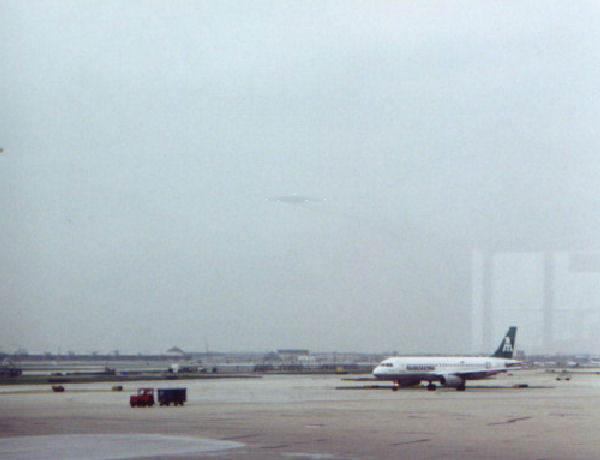
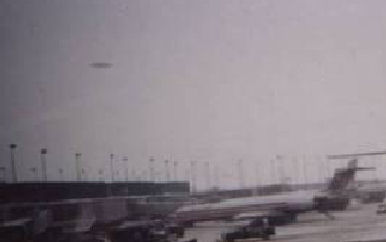
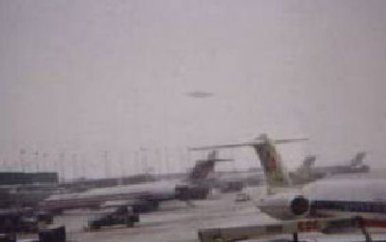
On the afternoon of November 7, 2006, at approximately 4:15 p.m. local time, multiple United Airlines employees at Chicago O'Hare International Airport observed a metallic, disc-shaped object hovering silently over United Airlines Gate C17 in the busy C Concourse. The witnesses included a diverse cross-section of experienced aviation professionals: ramp workers, mechanics, supervisors, and pilots — personnel who spend their working days in proximity to aircraft of every type and who can readily distinguish known aircraft from unusual objects.
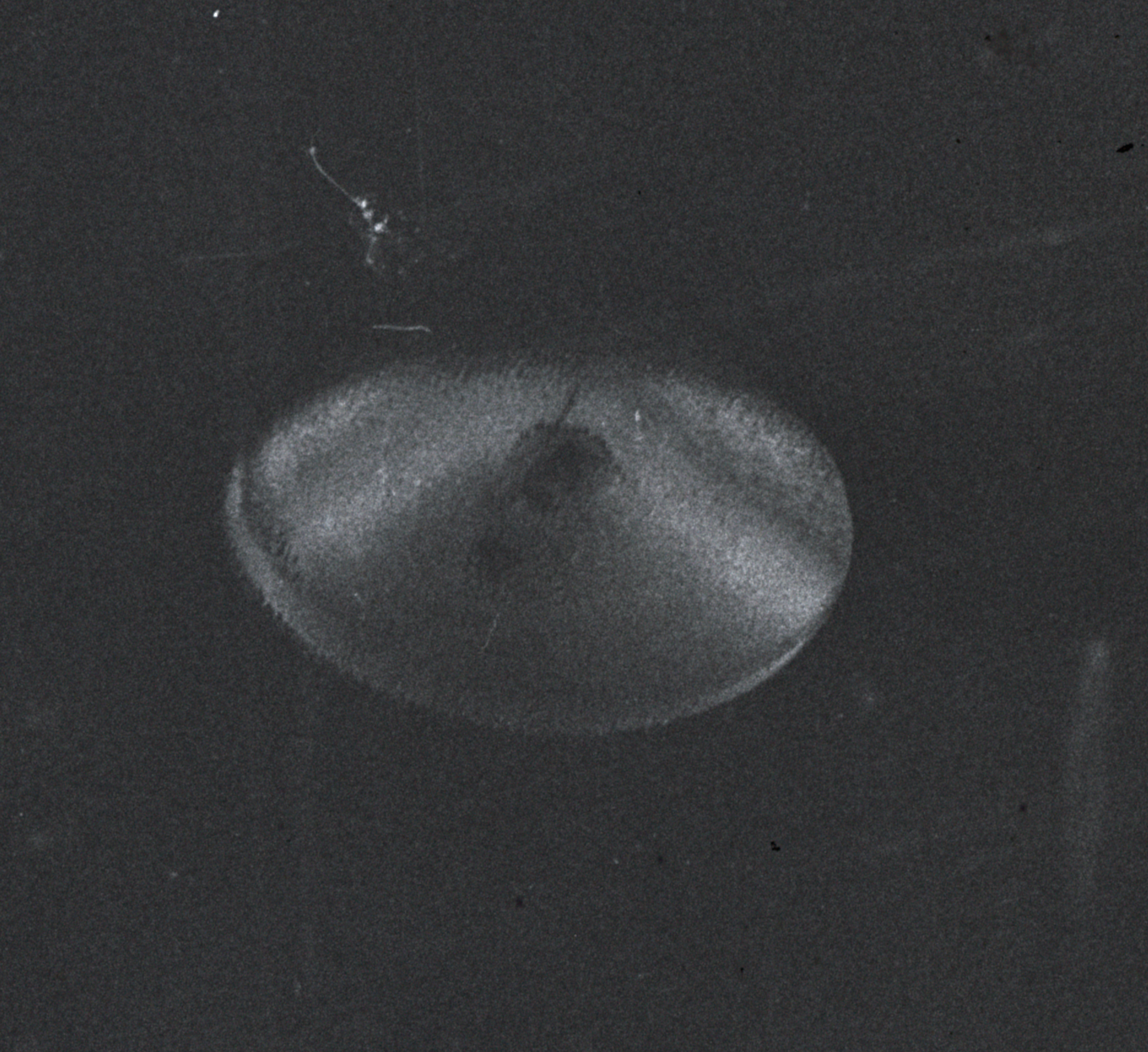
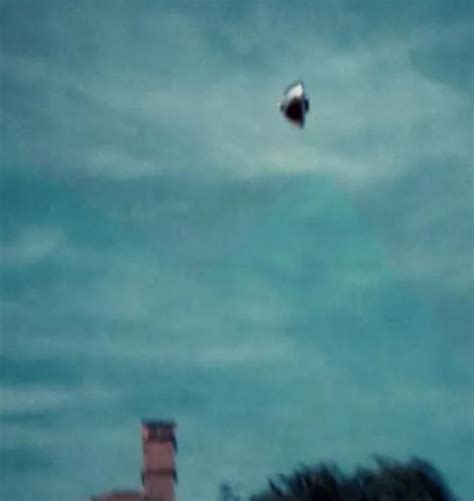
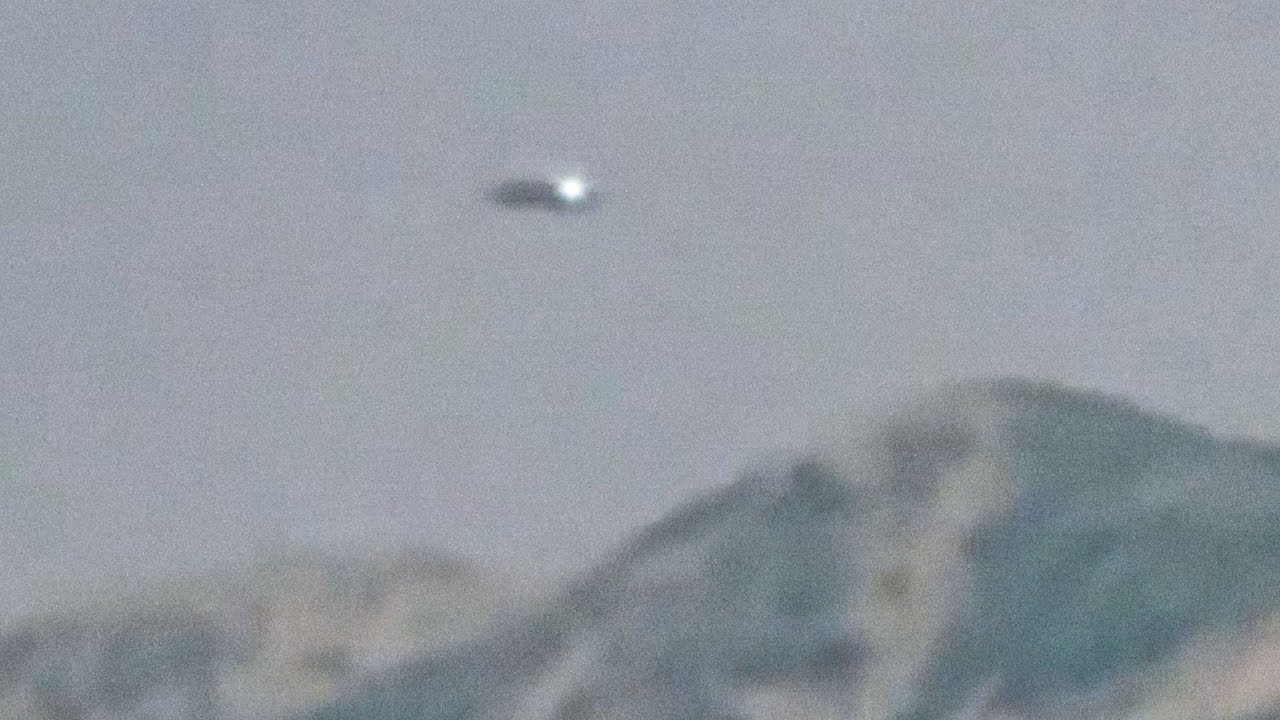
The object was described consistently across multiple witnesses as a dark, metallic disc with no visible propulsion system, windows, markings, or rotating elements. It hovered motionlessly at approximately 1,500 feet above the gate area — well within the controlled airspace of one of the busiest airports in the world. Witnesses estimated its diameter at approximately 6 to 24 feet, a range reflecting differences in estimating distance without a known reference object. All witnesses agreed on the object's general disc morphology, metallic appearance, and absolute silence despite hovering at close range in an airport environment otherwise filled with aircraft engine noise.
The object remained stationary for an estimated two to five minutes. During this time, multiple United employees on the ramp called in to the United Airlines operations center to report the object, and the supervisor on duty confirmed the visual. At least one United pilot confirmed the sighting from the cockpit of an aircraft at the adjacent gate. When the object finally departed, it did so vertically — shooting straight upward through the overcast cloud layer at high speed, leaving a perfectly circular hole in the cloud deck through which the witnesses observed blue sky briefly before the hole closed over. This "hole punch" effect in the cloud layer, described consistently by multiple witnesses, is one of the most distinctive physical phenomena associated with the encounter.
The incident occurred in the late afternoon during normal operations at one of the world's busiest airports, with hundreds of aviation professionals present on the ramps and taxiways. Despite the favorable conditions for observation — multiple trained witnesses, daylight, proximity to the object, and an extended hover period — no photographs or video of the object were captured. By the time witnesses recognized the significance of what they were seeing and reached for phones or cameras, the object had already departed.
The case came to public attention through investigative reporting by Jon Hilkevitch of the Chicago Tribune, published January 1, 2007. Hilkevitch obtained audio recordings of communications between United Airlines employees and air traffic control during the sighting through a Freedom of Information Act request to the FAA. The story generated substantial national and international news coverage and prompted follow-up investigation by the Mutual UFO Network (MUFON) and other civilian researchers who interviewed the witnesses and documented their accounts.
The Federal Aviation Administration initially stated that it had no record of any pilot or airline reporting an unusual object at O'Hare on November 7, 2006. This statement proved inaccurate: Hilkevitch's FOIA request produced audio recordings and written communications confirming that United Airlines had indeed reported the object to FAA air traffic controllers during the sighting. The FAA's initial denial — later revised to acknowledge the reports — became a significant element of the case, raising questions about the accuracy and completeness of the agency's initial public communication.
After the Chicago Tribune story broke and generated nationwide attention, the FAA issued its official explanation: the sighting was most likely a weather phenomenon, specifically a "hole punch cloud" caused by aircraft flying through the cloud deck. The FAA did not conduct an investigation of the witnesses or systematically review the communications records. The weather explanation was offered without demonstrating that a hole punch cloud could appear below an overcast rather than within it, or that such a phenomenon could produce the dark metallic object observed hovering below the cloud base before the hole appeared above it.
United Airlines conducted no formal investigation of the incident and declined to comment publicly beyond acknowledging that employees had reported an unusual sighting. The airline's communications infrastructure at O'Hare had captured contemporaneous records of the reports — the audio recordings obtained through FOIA — but the airline did not facilitate systematic witness interviews or share additional documentation with investigators or the public.
MUFON investigators conducted the most thorough civilian investigation of the case, interviewing approximately a dozen witnesses and documenting their accounts. The witness statements showed remarkable consistency in object description, duration, and the "hole punch" departure effect despite the witnesses having had no coordinated opportunity to compare accounts before the interviews. MUFON's analysis concluded that no conventional explanation — weather phenomenon, known aircraft, or optical illusion — adequately accounted for all elements of the multiple-witness accounts.
No radar contact was established for the object during the sighting, a point cited by the FAA and skeptics as evidence against a real physical object. O'Hare airport's TRACON radar, however, operates on specific scan frequencies and angles optimized for tracking transponder-equipped aircraft and may not reliably detect a small, low-altitude, transponder-free object hovering below the cloud deck. The absence of a radar return is therefore ambiguous rather than definitively disconfirming, particularly for an object hovering in the radar's ground clutter zone directly below an active flight deck.
The FAA's official conclusion — that the sighting was likely a weather phenomenon — has not been accepted by the witnesses, civilian investigators, or aviation safety researchers as a satisfactory explanation for the totality of the observed events. The weather explanation does not account for the solid, metallic disc described by trained aviation observers hovering below the cloud base before any hole appeared above, nor does it explain why multiple experienced professionals independently described the same structured object rather than a diffuse atmospheric effect.
The O'Hare case is particularly significant for the quality of its witnesses. United Airlines ramp workers, mechanics, supervisors, and pilots are among the most experienced observers of aerial objects in any professional category. Their familiarity with every class of conventional aircraft, drone, weather balloon, and atmospheric optical effect makes their consistent reports of an unknown disc especially credible and their professional consensus about the object's anomalous nature especially meaningful.
The case demonstrated a recurring institutional pattern: an initial FAA denial of any report, followed by a FOIA-compelled correction when documentation proved the initial denial false, followed by a cursory conventional explanation offered without systematic witness interviews or technical analysis. This response pattern — which UAP researchers have documented across dozens of cases — has contributed to widespread aviation professional reluctance to formally report UAP encounters, knowing the reports will receive inadequate investigation and may attract career attention without any institutional benefit.
The O'Hare sighting remains one of the best-documented daytime UAP encounters at a major civil aviation facility in the modern record, distinguished by the number and professional quality of its witnesses, the consistent "hole punch" departure effect, and the documented FAA communications confirming the reports. It is regularly cited in aviation safety discussions as evidence that UAP incidents at commercial airports warrant systematic investigation protocols that do not currently exist.
- Q.01What caused the circular hole in the cloud deck above the departure point? Multiple witnesses independently described a perfectly circular aperture opening in the overcast layer immediately above where the object had hovered after the object shot vertically through the cloud. What physical mechanism — whether from propulsion, pressure wave, thermal effect, or some other source — could produce a circular hole in an overcast cloud layer during a rapid vertical departure has not been analyzed in any published aerodynamic or atmospheric study of the case.
- Q.02Why did O'Hare's radar systems not detect the object? The absence of a radar return is cited as evidence against a real physical object. However, O'Hare's TRACON radar is optimized for transponder-equipped aircraft and may not reliably detect a small, low-altitude, hovering, non-transponder object in the airport's ground clutter zone. A definitive assessment of whether the radar should have detected an object of the described characteristics in the described position has not been publicly published by any radar engineer with access to the relevant system parameters.
- Q.03Were there any other witnesses on incoming or outgoing aircraft with direct sightlines to Gate C17? Hundreds of aircraft were in the O'Hare traffic pattern during the sighting window. Pilots on approach, taxiing, or departing during the 4:15 p.m. period may have had visual sightlines to the object. Whether any pilot reports from other airlines were filed with ATC or the FAA during the same period, and whether these were reviewed by investigators, has not been established in public accounts.
- Q.04Why did United Airlines not conduct a formal investigation given the number of its employees involved? Multiple United employees — including supervisors and pilots — contemporaneously reported an unusual object during working hours in an active operational area. Standard airline safety management protocols would typically generate a formal incident report for an event attracting this level of employee attention. Whether United's safety management system produced any formal documentation of the incident beyond the ATC audio captured by Hilkevitch's FOIA request has not been publicly established.
- Q.05Could airport security camera footage have captured the object or its departure effect? O'Hare maintains extensive camera coverage of its ramp areas, gates, and approach corridors. Whether any airport security camera or FAA camera system was positioned to have captured the object during its hover or departure — and whether that footage was reviewed by any official investigative body — has not been addressed in public accounts of the official response.
- Q.06What does the O'Hare case reveal about the need for standardized UAP reporting protocols in commercial aviation? O'Hare 2006 illustrates a systemic gap: dozens of trained aviation observers at the world's busiest airport witnessed an apparently anomalous object, and the result was an inaccurate initial FAA denial, a cursory official explanation, no systematic witness interviews, and no formal investigation by either the airline or the aviation authority. The case has been central to advocacy by NARCAP and aviation safety researchers for standardized, non-stigmatizing UAP reporting channels for commercial aviation personnel — a gap that remains only partially addressed by the reporting reforms of the 2020s, which have focused primarily on military rather than civilian aviation reporting infrastructure.