
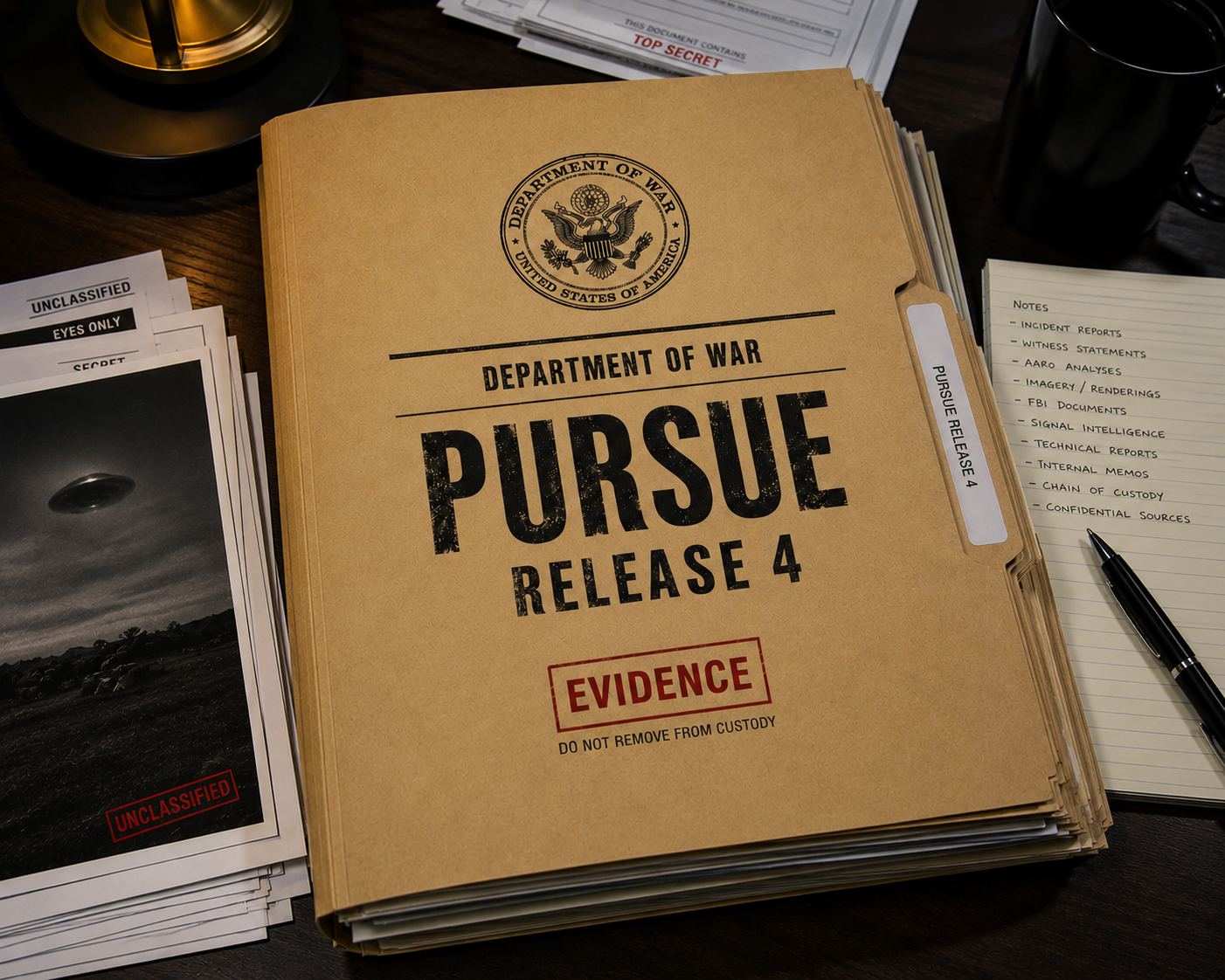
On July 10, 2026, the Department of War published its fourth tranche of declassified UAP records under the Presidential Unsealing and Reporting System for UAP Encounters, known as PURSUE. The release adds 40 new files — 14 documents, 19 videos, 4 audio recordings, and 3 images — drawn from the CIA, Department of Energy, Department of War, FBI, and NASA. It brings the total PURSUE archive to 334 records.
PURSUE is the government's rolling public-release program for unresolved UAP records, launched May 8 under an executive order signed by President Trump. The Department of War publishes new tranches every few weeks as materials are discovered and declassified. Release 04 arrived 28 days after Release 03 on June 12.
Assistant to the Secretary of War for Public Affairs Sean Parnell confirmed the release, noting that the department and its agency partners are actively working on the next tranche. The new files are publicly available at WAR.GOV/UFO under the Release 04 tab.
Historical Documents: Project Sign, Los Alamos, and Early Air Force Studies
The archival core of Release 04 clusters around the late 1940s — the formative years of the U.S. military's engagement with the UFO question.
Project Sign Progress Report (1948). DOW-UAP-D097 is the initial report from Project Sign, the Air Force's first formal UFO investigation program, established in late 1947. Prepared at Wright-Patterson Field and signed by Colonel H.M. McCoy, the document consolidates roughly 100 incidents from April 1946 to January 1948. Investigators consulted Nobel laureate Irving Langmuir at General Electric and examined whether experimental flying-wing designs using boundary-layer control could account for some sightings.
Analysis of Flying Object Incidents in the United States (1948–1949). DOW-UAP-D093 and DOW-UAP-D094 are two versions of Air Intelligence Report No. 100-203-79, also known as Study 203. Analysts reviewed more than 200 reports, weighing the credibility of Air Force officers, commercial pilots, weather bureau staff, and engineers. The study concluded: "It must be accepted that some type of flying objects have been observed." Among its early cases: two Weather Bureau employees in Richmond, Virginia, tracking balloons with a theodolite reported two metallic discs in April 1947 — two months before Kenneth Arnold's famous June sighting.
Los Alamos Conference on Aerial Phenomena (1949). DOE-UAP-D004 is a 24-page transcript of a conference convened to study the wave of luminous green fireballs that had lit up New Mexico's skies since December 1948. The attendee list reads like a roll call of the era's national-security establishment: Edward Teller, Norris Bradbury, Lincoln LaPaz, plus representatives from the Atomic Energy Commission, Air Force, Army, FBI, and the Armed Forces Special Weapons Project. The conference ultimately led to the short-lived Project Twinkle observation network.
Modern Sensor Videos: 19 Unresolved UAP Reports
Nearly half of Release 04 consists of video files — 19 infrared and electro-optical recordings from military platforms spanning the Middle East, the Yellow Sea, the East and South China Seas, the Atlantic Ocean, and broad eastern and western U.S. locations. The files range from 2015 to 2025.
The strongest geographic cluster is in the Indo-Pacific. U.S. Indo-Pacific Command submitted multiple records, including:
- Yellow Sea, 2025 (PR104) — 18 seconds of infrared footage in which the sensor tracks an area of contrast resembling a six-pointed star.
- East China Sea, 2025 (PR105) — The longest single video in Release 04 at nearly 5 minutes, showing a sensor panning and zooming on a contrast area that intermittently loses distinction against the background.
- South China Sea, 2024 (PR101) — 1 minute 46 seconds capturing a line of several contrasts moving bottom-right to top-left.
- Yellow Sea, 2023 (PR100) — 4 minutes 57 seconds of electro-optical and infrared footage showing a dark shape against a blue background.
Additional cases include Middle East recordings from 2023 (PR024, PR030), Atlantic Ocean videos from 2016 and 2020, and multiple Eastern and Western U.S. sightings from 2015 to 2020.
Two files carry notable caveats from the All-domain Anomaly Resolution Office. DOW-UAP-PR113, a 1996 Western U.S. video of two disc-shaped objects, was digitally altered before it reached the UAP Task Force — no formal data-handling practices existed at the time. DOW-UAP-PR115, an 8-second 2019 Gulf of America clip, is paired with a sensor-effect explanation: infrared auto-gain filters can make a tracked source appear to flicker when its temperature is close to the surrounding environment.
Every file in the release carries the same disclaimer: the video description is provided for informational purposes only and should not be read as an analytical judgment, investigative conclusion, or factual determination about the event's validity, nature, or significance.
NASA Material: STS-80 Photographs and Apollo Audio
Three photographs from NASA's STS-80 Space Shuttle Columbia mission (November–December 1996) show an unidentified object in low-Earth orbit. The images — NASA-UAP-D030, D031, and D032 — are the first primary-source STS-80 frames released under PURSUE. STS-80 is a mission with a documented public history of anomalous observations reported by crew members. The photographs show the object near the center of the frame, to the right of the Earth's limb, at an altitude of approximately 217 miles.
Four NASA audio files include two Apollo 14 crew debriefing segments from 1971 and two Apollo 17 crew medical debriefing segments from 1972. The recordings discuss the "light flash phenomenon" — streaks and flashes of light astronauts perceived with their eyes closed, a documented biological effect from cosmic rays passing through the retina. The phenomenon has been studied extensively in space medicine and is not considered anomalous, though its inclusion in a UAP release signals the breadth of NASA material being declassified.
Release 04 also includes a 2015 Department of Energy report documenting an unidentified object that entered airspace over the Pantex nuclear-weapons plant near Amarillo, Texas, prompting a facility lockdown. Security officers tracked the diamond-shaped object for several miles before it departed the area.
What Release 04 Means for the PURSUE Program
Release 04 is the smallest PURSUE batch so far — the opening tranche on May 8 carried 158 records, followed by 64 on May 22 and 72 on June 12. But it is among the most concentrated, with nearly half its entries being video files and its historical material clustered around the institutional origins of the UFO question.
The Department of War has now published 334 records across four tranches since the program launched less than three months ago. The pace of releases — roughly every two to four weeks — has held steady through the summer, with each batch drawing from an expanding roster of contributing agencies.
The materials represent unresolved cases — meaning the government is unable to make a definitive determination on the nature of the observed phenomena. The agency continues to welcome private-sector analysis and expertise, and has confirmed that additional releases are forthcoming.