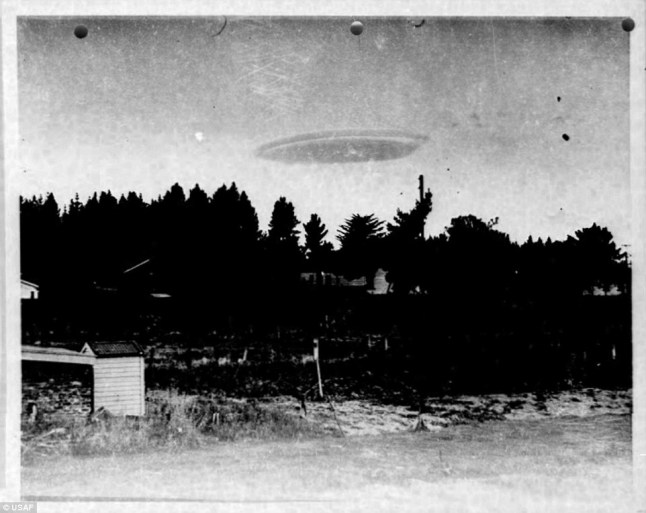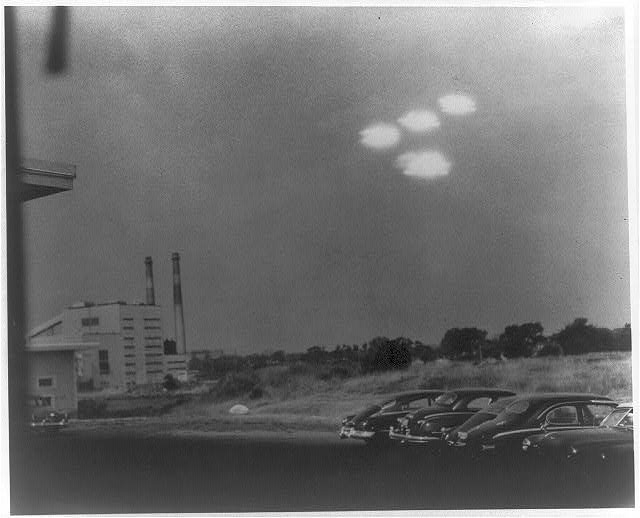
At 9:35 in the morning on July 16, 1952, Seaman Shell R. Alpert, a 21-year-old U.S. Coast Guard photographer assigned to the air station at Salem, Massachusetts, was seated in the base photographic laboratory with his back to the window, cleaning a camera and filing negatives. He turned slightly toward the window and noticed an unusual brightness in the sky outside. What he saw stopped him.
I was sitting in the photo office filing negatives with my back toward the window when I turned slightly in the direction of the window and noticed something bright outside. I observed the sky and saw what appeared to be several bright, almost brilliant lights slightly on the starboard side of the power plant smokestacks.
Shell R. Alpert, Seaman, U.S. Coast Guard · official statement, July 1952Four luminous objects were visible, arranged in a loose V formation, hovering and wavering in the sky above the power plant stacks visible from the laboratory window. Alpert grabbed the camera he had been cleaning from his desk. He was not certain whether it contained film. It did. As he raised the camera, the lights began to dim. Alpert ran outside and shouted to his colleague, Coastguardsman Thomas E. Flaherty, who was nearby. The two men ran back inside the photo lab together. The lights had brightened again. Alpert raised the camera to the window and fired the shutter. The result was Official U.S. Coast Guard Photograph Number 5554, the image that would become one of the most analyzed, debated, and widely reproduced UFO photographs of the 1950s.
They were wavering. They appeared to dim slightly and then brighten again. By the time I had focused my camera they had dimmed somewhat.
Shell R. Alpert · initial report to Coast Guard superiors, July 1952Flaherty corroborated the sighting. He confirmed that he had looked into the sky from Alpert's position and observed the lights before they dimmed fully. His testimony established the photograph as having at least two independent eyewitnesses, both active-duty U.S. military personnel, both of whom were able to describe the objects consistently.
The Salem photograph was taken at the peak of the most concentrated period of UFO sightings in American history. In the summer of 1952, Project Blue Book was receiving reports at a rate it had never previously experienced. Three days after Alpert took his photograph, on July 19 and 20, multiple radar systems at Washington National Airport and Andrews Air Force Base tracked unidentified objects over restricted airspace above the U.S. Capitol. That event, and a repeat on July 26 and 27, produced the largest peacetime Pentagon press conference since World War II. At that same conference on July 29, 1952, a copy of Alpert's photograph was present in the briefcase of Captain E.J. Smith, and General John A. Samford's face appeared in newspaper coverage alongside the Salem story. The photograph and the Washington radar incidents were treated by the press as part of the same national moment of genuine institutional uncertainty about what was in American airspace.
Alpert's photographic print was handed to his superior officer within hours of the event. It was flown to Coast Guard Headquarters in Washington, D.C., and from there transported to Wright-Patterson Air Force Base in Ohio, home of Project Blue Book and the Air Technical Intelligence Center. The photograph was shown to personnel at the Pentagon and was present at the July 29 press conference called by General Samford. The speed and seriousness with which the image moved through official channels reflects the institutional weight given to a photograph taken by an on-duty military photographer using government-issue equipment at a U.S. military installation.
Alpert surrendered the print to his Coast Guard superior officer on July 16, 1952. It was flown to Coast Guard Headquarters, Washington D.C., and then delivered to Wright-Patterson Air Force Base for Project Blue Book analysis. A copy was present at the Pentagon during General Samford's July 29 press conference. The photograph is now held in the Library of Congress Prints and Photographs Division under call number SSF: Unidentified Flying Objects, Reproduction Number LC-USZ62-44252, with no restrictions on publication.
Project Blue Book conducted three separate analyses of the Salem photograph. Each reached a different conclusion, and the three contradictions collectively produced the final determination of unexplained:
The photograph was widely reproduced in newspapers across North America by the end of July 1952. Papers reported that the Air Force was actively examining the image. A number of articles stated that the Air Force assured the public the objects posed no menace and were the result of weather phenomena or optical illusions, a statement that was not accompanied by any technical analysis specific to the Salem photograph and that contradicted the program's own internal classification of the case as unexplained.
Under this sustained pressure, Alpert was eventually pushed to issue a qualifying public statement through the Coast Guard's press office. He shifted his description from what he had initially told his superior officers:
I cannot, in all honesty, say that I saw objects or aircraft, merely some manner of lights. A quick flash. I actually could not say it was anything. It could have been reflections from passing cars or from the ocean.
Shell R. Alpert, Coast Guard press release statement, issued under institutional pressure · late July 1952The retraction stands in direct tension with Alpert's original description: a deliberate observation made over a period of time sufficient for him to run outside, call a colleague, return inside, and raise a camera to the window. His initial account describes wavering lights that dimmed and then brightened again across multiple seconds of sustained observation. The press release statement was widely noted at the time as inconsistent with the original report and has been assessed by subsequent researchers as the product of institutional pressure rather than a genuine reconsideration of what he had witnessed.
Project Blue Book's final classification of the Salem photograph as unexplained represents the Air Force's acknowledgment that three separate analytical attempts failed to produce a credible conventional explanation. The photograph is held in the Library of Congress with no known restrictions on publication, catalogued under the subject heading Unidentified Flying Objects. Its institutional provenance is essentially unimpeachable: it is an official U.S. Coast Guard photograph taken by an on-duty military photographer at a government installation, assigned a formal photograph number, and processed through the official government chain of custody within hours of its creation.
The most persistent conventional explanation is that the objects are internal reflections within the photographic laboratory itself, visible through the window and captured on film. Blue Book investigators who attempted to reproduce this effect by setting up lights in the parking lot visible through the same window were unable to match the configuration or brightness of the four objects. No interior light source in the laboratory has been identified that could account for four distinct bright elliptical forms in V formation as they appear in the photograph. The window screen through which the photograph was taken adds a further complicating factor: the screen pattern is faintly visible in the image and would have diffused any internal reflection rather than sharpening it.
The Salem photograph occupies a unique position in the UFO photographic record as one of a small number of images that is simultaneously an official government document, the product of an on-duty military photographer, corroborated by a second military witness, filed through an unbroken government chain of custody, subjected to multiple official analyses, classified as unexplained by the investigating agency, and now permanently archived at the Library of Congress. No subsequent analysis has improved on Blue Book's final determination.
- Q.01What were the four luminous objects? Blue Book's three analyses produced three contradictory conclusions, none of which could be demonstrated technically. The final determination was unexplained. No subsequent investigation has produced a credible matching identification.
- Q.02Was Alpert's retraction statement a genuine reconsideration or the product of institutional pressure? His original account describes a sustained, deliberate observation lasting long enough for him to leave the room, summon a colleague, and return. His press release statement characterizes the same experience as a quick flash. These descriptions are materially inconsistent.
- Q.03The Blue Book reproduction attempt, setting up string lights in the parking lot, failed to match the photograph. What precisely were the conditions of that attempt, and has any subsequent researcher attempted a controlled photographic reproduction using the same window, screen, and comparable film stock?
- Q.04Thomas Flaherty corroborated the sighting. Has his full statement ever been published? The declassified Blue Book file for Case 1501 at NARA contains the investigation documents. Has anyone reviewed them in full and published Flaherty's independent account?
- Q.05The photograph was taken three days before the July 19 Washington D.C. radar incidents and was present at the July 29 Pentagon press conference. Was there any internal Air Force or CIA assessment that linked the Salem objects to the Washington radar contacts occurring in the same geographic region during the same two-week period?
- Q.06The photograph is now held by the Library of Congress with no publication restrictions. Has a high-resolution scan of the original print been subjected to modern digital photogrammetric analysis to determine whether the four objects are at the same focal plane as the background, which would help resolve whether they were external objects or internal reflections captured in the photographic plane?