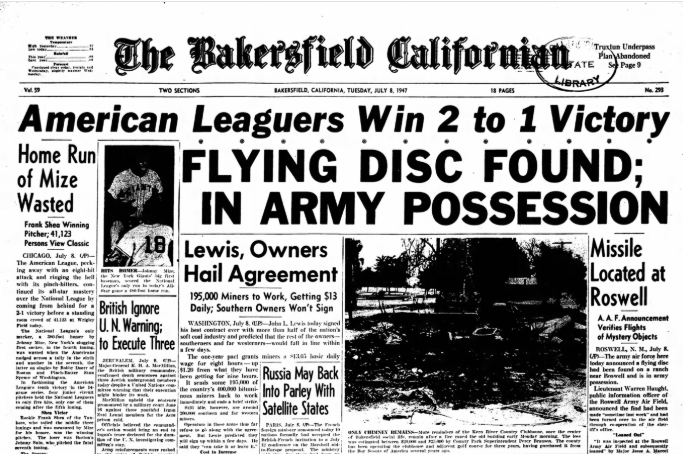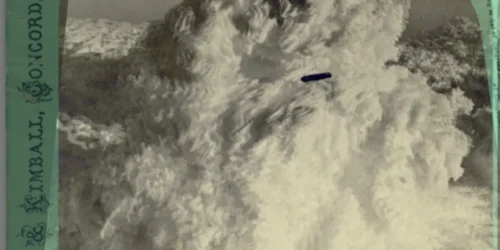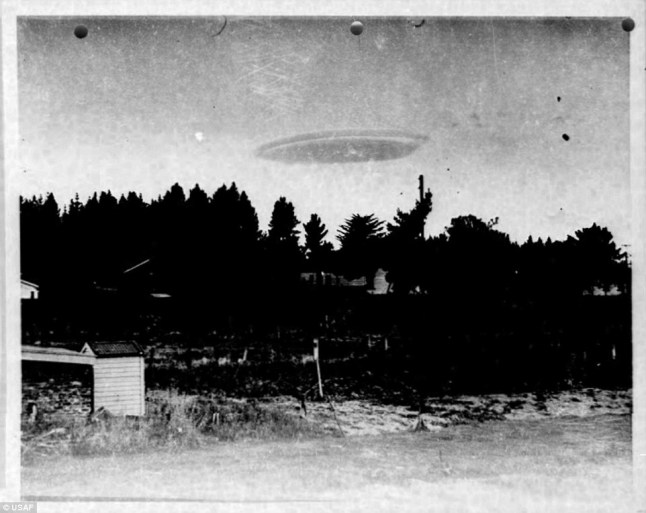
On June 24, 1947, private pilot and businessman Kenneth Arnold was flying his CallAir A-2 aircraft on a solo flight from Chehalis, Washington to Yakima, Washington. He had diverted from his direct route to assist in the search for a missing Marine Corps C-46 transport aircraft reported down somewhere in the Cascade Mountains. It was during this search flight that Arnold encountered what would become the most consequential UAP sighting in modern history — the event that launched the "flying saucer" era and transformed the public understanding of anomalous aerial phenomena.
At approximately 3:00 p.m., flying at roughly 9,200 feet near Mount Rainier, Arnold observed a brilliant flash of light. Scanning the sky to identify its source, he spotted a formation of nine unusual objects flying in a roughly echelon formation from north to south at an altitude he estimated at 9,500 feet. The objects were flying at remarkable speed between Mount Rainier and Mount Adams — a known distance that Arnold used as a geographic baseline to calculate their velocity by timing their transit with his instrument panel clock.
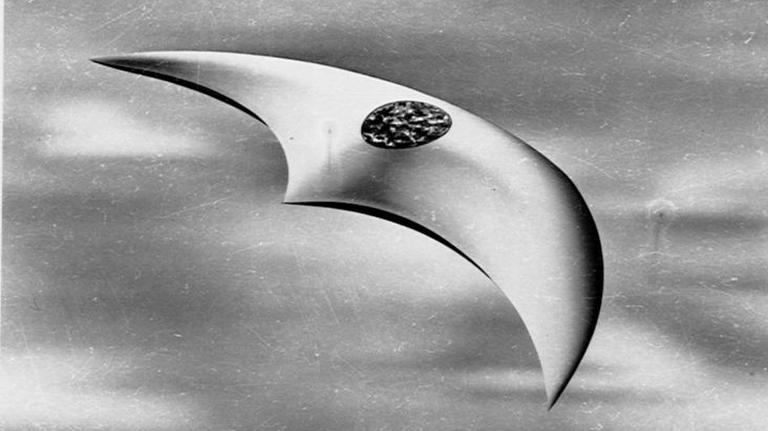
Arnold clocked the objects against these landmarks and calculated their speed at approximately 1,200 miles per hour — far exceeding any aircraft in service in 1947, at a time when the sound barrier had not yet been officially broken. He described the objects as crescent- or bat-wing-shaped, highly reflective — "like mirrors" in sunlight — and noted that they flew in a weaving chain, each object moving with an undulating motion he later described as like "saucers skipping on water." It was this description of motion, not shape, that press reports transformed into the phrase "flying saucer."
Upon landing in Yakima, Arnold immediately reported his observations to aviation pioneer Al Baxter and other pilots. He subsequently filed a detailed written report with the Army Air Forces and agreed to a newspaper interview after his account reached a local reporter. The Associated Press wire service distributed the story nationally within days, producing worldwide coverage. Arnold was deeply frustrated by how his words were sensationalized — he had described how the objects moved, not their shape — but the term "flying saucer" entered the language and the imagination of the postwar world permanently.
Arnold was an experienced pilot with over 4,000 logged hours, including extensive mountain flying and aerial fire patrol work that made him thoroughly familiar with normal atmospheric optical phenomena, conventional aircraft silhouettes, and meteorological effects common over the Pacific Northwest. He consistently maintained the accuracy and precision of his account until his death in 1984, and remained frustrated throughout his life by both those who disbelieved him and those who exaggerated his account beyond what he actually reported.
The U.S. Army Air Forces collected Arnold's formal written report through its intelligence channels in the summer of 1947. This report became one of the earliest documents in what would eventually grow into the massive government archive of UAP incident reports. The immediate investigation was limited in scope; no aircraft matching Arnold's description were identified in operational records, and no radar data from the relevant area of the Cascades was available to independently corroborate the sighting.
The incident became a foundational case for Project Sign, the first official U.S. government UFO investigation program established in January 1948. Sign analysts reviewed Arnold's testimony in detail and attempted to identify alternative explanations including mirage effects, reflections from cloud layers, and misidentification of conventional aircraft flying in formation. No satisfactory conventional explanation was produced that accounted for the combination of the objects' calculated velocity, their visual appearance, and the formation behavior described by a witness of Arnold's demonstrated competence.
Project Sign was succeeded by Project Grudge and then Project Blue Book, which maintained the Arnold case in its files throughout the program's existence from 1952 to 1969. Blue Book's final evaluation classified the Arnold sighting as "unidentified" — no conventional explanation could account for the observed characteristics as reported by the witness. Independent scientists who reviewed the case, including atmospheric physicist Dr. James McDonald, concluded it was a genuine encounter with objects whose performance characteristics exceeded known 1947 technology.
Various alternative explanations have been proposed and evaluated over the decades: ice crystals, lenticular clouds, pelicans, and classified military test aircraft among them. Each has been found inconsistent with specific elements of Arnold's account — particularly the precisely calculated velocity of approximately 1,200 mph derived from known geographic reference points, the reflective quality of the objects, and their distinctive undulating formation flight pattern. No single alternative explanation has been accepted as conclusively matching all reported characteristics.
Dr. James McDonald, one of the most scientifically rigorous UAP investigators of the 1960s, analyzed the Arnold sighting in detail including a review of the meteorological and optical conditions over the Cascades on June 24, 1947. McDonald found no atmospheric mechanism that could produce the observed effect as a natural phenomenon and concluded the case warranted serious scientific attention — a position at odds with the Air Force's general posture of minimizing UAP reports during the Blue Book era.
The official conclusion across all government investigations — Project Sign, Project Grudge, and Project Blue Book — has been "unidentified." Despite more than seven decades of analysis, no conventional explanation has been formally accepted that fully accounts for all elements of Arnold's account, particularly the calculated speed of approximately 1,200 mph derived from precise geographic reference points, the formation flight of nine objects, and their distinctive reflective, crescent-shaped appearance.
The significance of the Arnold sighting extends far beyond its status as a single unexplained event. It triggered a national wave of sightings, generated the cultural vocabulary of "flying saucers" that shaped all subsequent public UAP discourse, and directly led to the establishment of the U.S. military's first formal UFO investigation programs. In this foundational sense, every official UAP investigation from 1948 through AARO's present operations traces its institutional lineage back to this single encounter over the Cascades.
Arnold's testimony has held up exceptionally well under long-term scrutiny. His technical competence as a mountain pilot, the specificity of his speed calculation derived from known geographic distances, and his consistent, precise account across many years of interviews distinguish him as one of the most credible witnesses in UAP history. His insistence that his descriptions had been misrepresented by press reports adds a layer of intellectual integrity that many other UAP witnesses cannot claim.
Whether the nine objects Arnold observed represented advanced human technology being tested secretly, a natural phenomenon unknown to 1947 science, or something of genuinely unknown origin remains an open question. The case's most important legacy is as a reminder that the contemporary UAP phenomenon has a documented history extending back at least to the mid-20th century — and that the official record has never produced a satisfactory explanation for even its most foundational case.
- Q.01How reliable was Arnold's speed calculation, and has it been independently reconstructed? Arnold timed the objects between Mount Rainier and Mount Adams using known distance and his instrument panel clock, arriving at approximately 1,200 mph. Subsequent analysts have varied in their acceptance of his timing methodology and baseline distance assumptions. A definitive reconstruction using verified 1947 geographic data and atmospheric conditions has never been formally published.
- Q.02Were any radar systems operating in the Pacific Northwest capable of detecting the objects on June 24, 1947? Postwar radar infrastructure was limited and unevenly deployed. Whether any radar facility was operational and positioned to detect objects at the altitude and range of Mount Rainier on that afternoon — and whether any archived records from such facilities survive — has not been definitively established in public accounts.
- Q.03Were other pilots or ground observers in the Cascades that day who might have independently observed the formation? Arnold was not the only person airborne in the region that afternoon. Whether other aviation professionals or ground observers reported anomalous aerial activity in the same area on June 24, 1947 was not systematically investigated in the immediate aftermath of the sighting.
- Q.04What classified military aviation programs were operating in the Pacific Northwest in mid-1947? The immediate postwar period saw extensive classified aircraft development and testing. Whether any program could account for nine highly reflective, crescent-shaped objects flying in formation at the reported velocity has not been addressed in declassified records from the War Department or successor agencies.
- Q.05How did Arnold's original descriptions differ from the "flying saucer" terminology that overtook them? Arnold consistently maintained that press reports misrepresented his account — the objects moved like saucers skipping on water, not the objects themselves were saucer-shaped. He described crescent- or bat-wing-shaped craft. The distinction matters significantly for understanding what he actually observed, yet the "flying saucer" framing has dominated popular accounts for seventy-five years, potentially distorting how the case is evaluated.
- Q.06What is the Arnold sighting's significance for understanding the long-term history of UAP? The 1947 Arnold encounter is the conventional starting point of the modern UAP era, but whether it represents the true beginning of a recognizable phenomenon or merely the beginning of systematic documentation of something much older is a foundational question. The Battle of Los Angeles in 1942 and even earlier reports suggest the phenomenon may predate 1947 considerably. Understanding what Arnold saw — and whether it belongs to the same category of phenomena that modern AARO is now investigating — has profound implications for how researchers and institutions understand the origin, duration, and nature of the UAP phenomenon as a whole.