On the evening of December 29, 1980, Betty Cash (aged 51), Vickie Landrum (57), and Vickie's grandson Colby Landrum (7) were driving home to Dayton, Texas, in Cash's Oldsmobile Cutlass after dining out. At approximately 9 p.m., while traveling on an isolated two-lane road through dense piney woods on FM 1485/2100, they observed a light above the treeline that they initially assumed was an airplane approaching Houston Intercontinental Airport, located about 35 miles away.
A few minutes later, on the winding roads, they observed the same light but now much closer and brighter. They described it as emanating from a huge diamond-shaped object hovering at approximately treetop level, with its base expelling flames and emitting intense heat. Landrum urged Cash to stop the car, fearing they would be burned if they continued forward. A born-again Christian, Landrum reportedly told her grandson Colby, "That's Jesus. He will not hurt us."
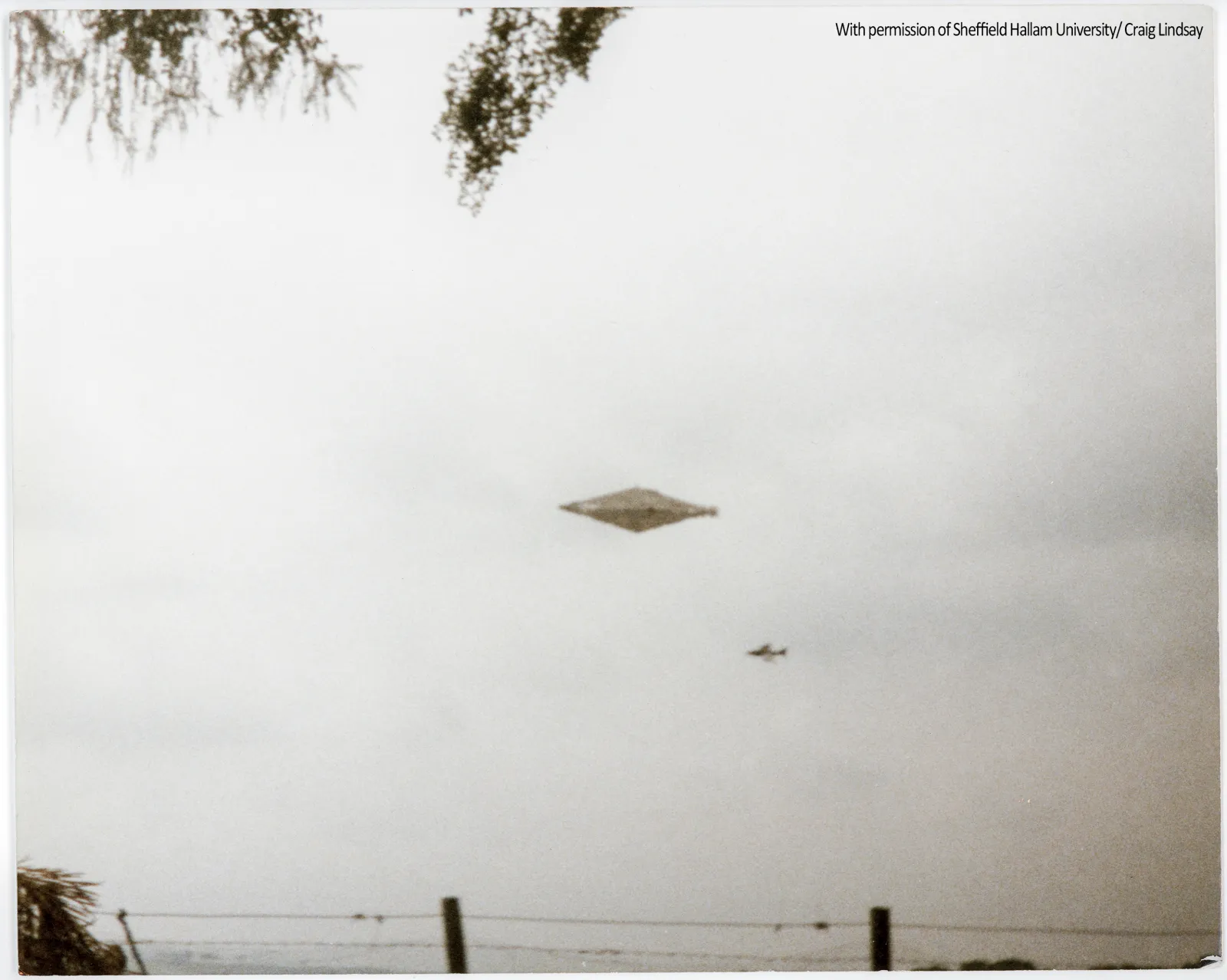
The object was described as intensely bright and dull metallic silver, shaped like a huge upright diamond—approximately the size of the Dayton water tower—with its top and bottom cut off flat rather than pointed. Small blue lights ringed the center, and flames periodically shot out from the bottom, flaring outward in a large cone. Each time the flames dissipated, the UFO floated a few feet downward toward the road, then rose again when the flames restarted.
The heat was intense enough to make the car's metal body painful to the touch. Cash later reported she had to use her coat to protect her hand from being burned when touching the door handle. When she touched the dashboard, Landrum claimed her hand pressed into softened vinyl, leaving an imprint that remained visible weeks later. This detail was documented on video shown in the 1985 HBO documentary UFOs: What's Going On.
After approximately 20 minutes, the object ascended above the treetops and rose higher into the sky. A group of helicopters then approached, surrounding the object in tight formation. Cash and Landrum counted 23 helicopters and identified some as tandem-rotor Boeing CH-47 Chinook helicopters. Cash specifically claimed they bore "United States Air Force" markings.
That night, all three witnesses experienced similar symptoms, though Cash was affected to the greatest degree. They reported suffering from nausea, vomiting, diarrhea, generalized weakness, a burning sensation in their eyes, and the sensation of severe sunburn.
Over the next few days, Cash's symptoms worsened, with many large, painful blisters forming on her skin. When taken to a hospital emergency room on January 3, 1981, she could not walk and had lost large patches of skin and clumps of hair. She was hospitalized for 12 days, though her condition improved little, and she returned for another 15-day stay. In the 1985 HBO documentary UFOs: What's Going On, Cash's hair loss was shown in photographs, and she claimed doctors switched from treating her for burns to treating her for radiation sickness after realizing she had been exposed to radiation. She was later treated for cancer.
The Landrums' health was somewhat better, though both suffered from lingering weakness, skin sores, and hair loss. In April 1981, Vickie was found to be developing a cataract in one eye, and Betty was first treated for breast cancer in 1983. Neither condition was known to have been present prior to their UFO encounter.
When Landrum telephoned various U.S. government agencies, she was referred to NASA aerospace engineer John Schuessler, who had long been interested in UFOs. With associates from the Mutual UFO Network (MUFON), Schuessler began researching the case and later wrote articles and a book on the subject. Astronomer Allan Hendry of the Center for UFO Studies (CUFOS) also briefly investigated.
In 1982, Lt. Col. George Sarran of the Office of the Inspector General of the United States Army began the only thorough formal governmental investigation. He could not find evidence that the helicopters belonged to any branch of the U.S. Armed Forces. Sarran stated that "Ms. Landrum and Ms. Cash were credible... the policeman and his wife [who claimed to have seen 12 helicopters near the site] were also credible witnesses. There was no perception that anyone was trying to exaggerate the truth."
Cash and Landrum sued the federal government for $20 million. Attorney Peter Gersten took on the case pro bono, and the case proceeded through U.S. courts for several years. Persuaded by testimony and evidence that no U.S. government agency possessed any such UFO and that no military personnel had operated any of the reported helicopters, a U.S. District Court judge dismissed the case on August 21, 1986.
The Texas Department of Health's Bureau of Radiation Control searched for residual radiation in the area but found none. To this day, there is no conclusive explanation of the night's events.
Several skeptical investigators have questioned the details and overall authenticity of the incident. Philip J. Klass noted inconsistencies in witness descriptions, the lack of pre-incident medical records, and the absence of detectable radiation. He suggested the witnesses may have been exposed to some form of contamination that left no trace.
In 1994, UFO skeptic Steuart Campbell suggested the witnesses may have observed a mirage of the star Canopus, which lay exactly in line with the road. Peter Brookesmith wrote that "skeptics have always asked a blunt and fundamental question: What was the trio's state of health before their alleged encounter?"
Gary P. Posner's analysis in The Reliability of UFO Witness Testimony concludes there are "myriad reasons for skepticism of virtually every aspect" of the case. He notes that Betty's actual medical records document she was initially hospitalized from January 2–19, 1981, and her attending physician noted "little, if any, hair loss" upon admission—though it did develop weeks later. Her dermatology consultant diagnosed only cellulitis with no mention of skin loss.
In December 2018, skeptic Brian Dunning investigated the case for the Skeptoid podcast. He found that Cash's doctor's notes attributed her hair loss to the autoimmune disease alopecia areata and that her other symptoms could have begun before the incident. Dunning concluded it was "completely plausible that Cash and Landrum wrongly, but honestly, placed the blame for their health problems onto whatever they saw."